Updated 2026-09-07
AI citation analysis: Turn cited sources into a content plan
AI citation analysis examines the pages an AI answer links to, the claims those pages support, and the gaps your team can address. Start with a stable set of buyer questions, preserve each answer and its exact source URLs, then decide whether to improve an existing page, supply missing evidence, or correct a third-party description. A citation is observable attribution; it does not reveal the engine's private selection logic or prove that a visit or sale followed.
When one buyer prompt opens several retrieval angles, use the query fan out SEO workflow to decide which gap belongs on one page, across a cluster, or in independent evidence.
SaaS teams can apply this method with the AI SEO for SaaS evidence system, which maps role-and-stage buyer questions to verifiable product, pricing, integration, security, and implementation pages.
For a platform-specific implementation, use the verification-first Perplexity SEO workflow to separate retrieval eligibility, answer usefulness, and observed citation selection.
A report that lists the most-cited domains leaves a practical question unanswered: what should the content team do next? The useful output is a small action list in which every proposed change points back to an answer, a cited passage, and a buyer need.
To turn that source evidence into a portfolio decision, use the AI search content strategy framework to assign one page owner and choose create, update, distribute, or skip.
This guide connects AI brand monitoring to a practical content decision using AEO Mantis's Monitoring and Sources screens. Use Monitoring to inspect an answer, Sources to find the pages behind recurring citations, and the worksheet below to record your editorial judgment.
Define what you are analyzing
Keep three observations separate:
- Brand mention: the answer names your company or product.
- Owned-page citation: the answer presents a link to a page on your domain as a source.
- Third-party coverage: a cited page on another domain discusses your brand, a competitor, or the category.
A competitor can receive a recommendation while your article supplies a definition. A review site can support a recommendation for your product without your domain receiving a citation. Record both the answer's treatment of the brand and the page behind the source link.
A link also needs inspection. The presence of a citation marker does not establish that its destination supports every nearby sentence. Open the source and compare the relevant passage with the answer. Mark support as clear, partial, contradictory, or unverified; do not fill an inaccessible page with assumptions.
1. Fix the question set and observation scope
Choose one valuable decision cluster, such as selecting software for a small agency. Use buyer prompts drawn from sales questions, support requests, and search language. Keep category-open questions separate from questions that already name your brand.
For each run, record the exact prompt, platform or search surface, language, target market, time, and collection method. If you know the displayed model or search setting, record it too. An API response and a consumer application's answer are separate observations unless you have evidence that the conditions match.
Preserve the full answer and visible source list. A successful answer with no citations is different from a failed collection. Record both, but exclude failed runs from a rate that claims to describe successfully collected answers. Keep an audit trail so a falling citation count cannot conceal a rising failure count.
Start with an answer in AEO Mantis
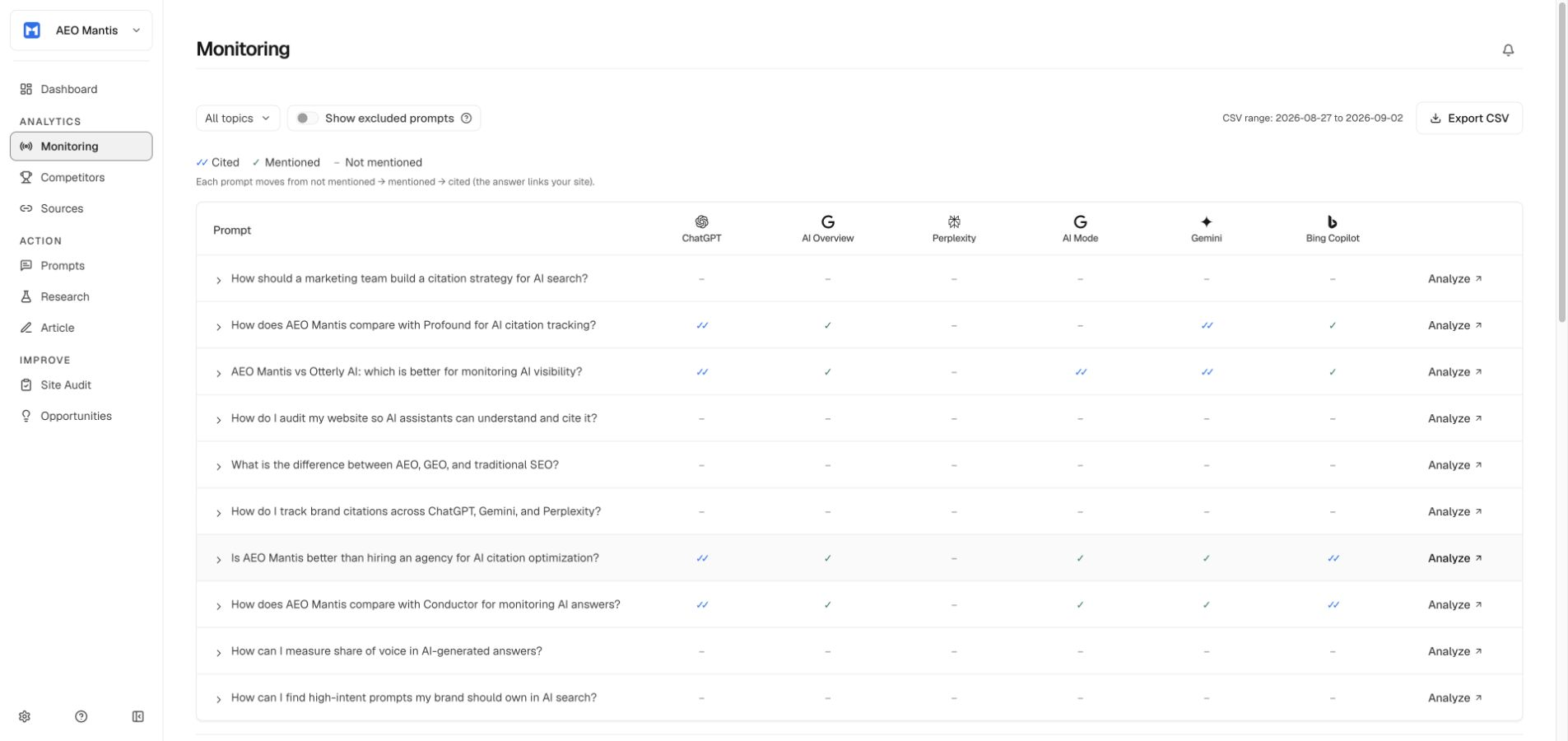
Open Monitoring, choose a topic, and compare the Cited, Mentioned, and Not mentioned states across platforms. In the screenshot, the AEO Mantis–Profound comparison prompt is cited on ChatGPT and Gemini but only mentioned on Google AI Overview. That is a reason to inspect the answers separately, rather than treating every mention as a link.
Select Analyze beside a prompt, choose a platform, and open Show original response to read the stored answer. Use that answer as your observation record; check the linked source itself before deciding which claim it supports.
2. Build a page-level evidence worksheet
Use one row per source URL per answer. When the same page appears twice in one answer, keep the markers for context but deduplicate it for this worksheet's page counts. This is a chosen counting rule; other tools may define their metrics differently.
A compact worksheet needs these fields:
- Observation: prompt ID, exact wording, platform, language, market, timestamp, and answer reference.
- Source: original cited URL, final destination if it redirects, page title, publisher, and source-check date.
- Claim: the answer excerpt associated with the source and the passage that supports or conflicts with it.
- Relationship: owned page, competitor page, independent editorial or review, community content, or reference material.
- Decision: buyer relevance, evidence gap, proposed action, owner, and next review date.
Retain the original URL before normalizing. Remove tracking parameters only when they do not change the content. Do not collapse translated pages, documentation versions, or different products into one record merely because they share a hostname. A domain summary is useful for navigation; the page and passage are the unit of editorial work.
For each cluster, report the number of successful answers, answers with visible citations, and unique cited pages. Use citation rate and other visibility metrics for the broader scorecard, with the denominator stated. A percentage calculated only from citation-bearing answers answers a different question from one calculated from all successful answers.
Find the cited pages in Sources
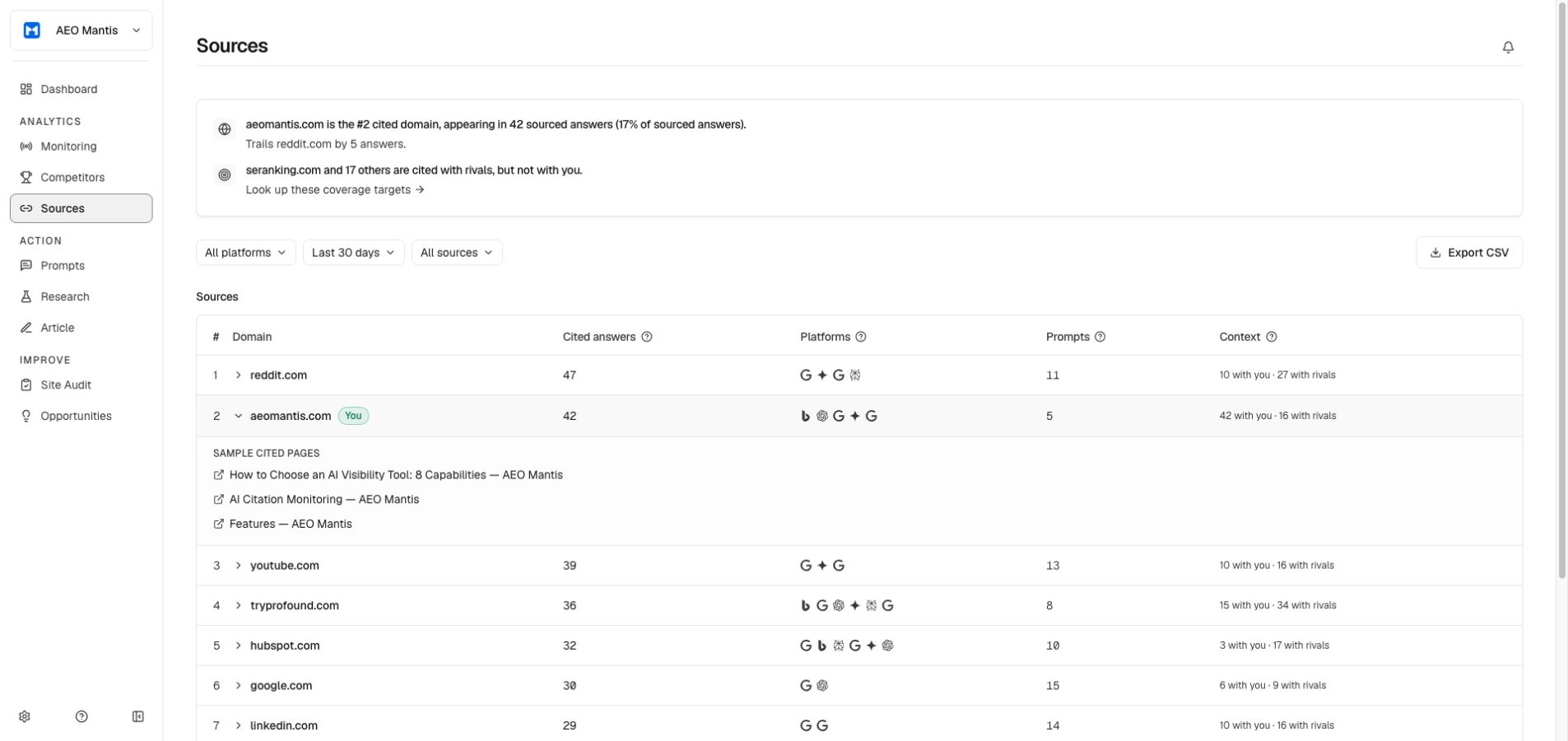
Open Sources and set the platform and date range for your review. The table shows Cited answers, Platforms, Prompts, and Context for each domain. Expand the arrow beside a domain to reveal Sample cited pages, then open a page to inspect its evidence.
In our own workspace below, expanding aeomantis.com reveals a tool-selection guide, the citation-monitoring feature page, and the features overview. Those pages serve different buyer needs. Record the exact page that addresses your question, rather than turning the domain's total into a claim about one article. The expanded list is a sample, so use the original answer when you need its complete source context.
3. Read what the cited page actually contributes
Inspect the recurring pages that answer an important buyer question. For each, ask what information the source supplies: a product fact, a comparison criterion, an implementation step, a definition, or independent evidence. Check whether the information is current and applicable to the market in the prompt.
Then compare your closest existing page against that specific need. Does it contain an accurate answer? Is the supporting evidence accessible? Is the statement easy to find in visible text? Does the page explain scope and limitations?
Write the conclusion in two parts: observed and hypothesis. For example, “The cited page contains a migration checklist; our matching page has none” is observable. “Adding a checklist will cause the engine to cite us” is an untested hypothesis. This distinction prevents a useful competitor observation from becoming an invented explanation of the ranking system.
Do not infer an engine's internal query from a cited page title. Google documents that AI search features may use related searches through query fan-out, but a visible citation list is not a complete log of those searches.
4. Choose an action that fits the evidence
Different gaps call for different work:
- The same intent is already served: refresh the existing URL with the missing explanation or proof. Avoid publishing a second page that competes for the same task.
- The question is genuinely distinct: propose a new page only when you can answer it with useful evidence and connect it to established content.
- A third-party page has an incorrect product fact: prepare a factual correction supported by a current primary source. Its publisher controls whether to accept it.
- A comparison cites evidence you cannot substantiate: obtain legitimate evidence or state the limitation. Do not invent testing, customer outcomes, or endorsements.
- A suitable owned page may be inaccessible: investigate the relevant crawler, indexability, canonical, and visible content before rewriting the article. Use the AI visibility audit worksheet to keep failed and untested checks separate and define the fix's acceptance evidence.
For Google AI Overviews and AI Mode, Google's documentation requires a supporting page to be indexed and eligible for a search snippet. It does not require special AI markup, and eligibility does not guarantee selection. Check retrieval access separately from controls for model training.
Prioritize actions with a clear buyer consequence, repeated supporting observations, and a change your team can execute. Treat a one-off citation as a lead to investigate. Do not buy a listing merely because its domain appeared in one answer.
Once you have verified the gap, use Article in AEO Mantis to start a draft from your findings, or Site Audit to investigate your own site before rewriting. Keep the source URL and the claim you checked in your brief so the proposed change stays tied to evidence.
5. Work through a concrete example
Illustrative example only — these are invented observations, not AEO Mantis or customer results. Suppose a team collects 12 successful answers for one agency-software decision cluster on a single platform and language. Nine answers show citations. Four cite the same competitor migration guide; two cite an independent comparison page that describes your export capability incorrectly.
The team checks its own migration page and finds that the export step is documented, but the file-format limitations are missing. It now has two bounded actions:
- Update the existing migration page with verified export steps, format limits, and the date checked. Keep the URL.
- Prepare a correction request for the independent comparison, pointing to the verified public documentation. Record whether the publisher responds and changes the page.
In the worksheet, the competitor guide appears in 4 of 12 successful answers, or about 33%. It appears in 4 of 9 citation-bearing answers, or about 44%. Both calculations are valid when labeled; they measure different populations. Neither number is the share of all customer conversations.
Keep the next review under the same scope. More citations after the change would be an encouraging observation, but this small uncontrolled example could not establish that the edit caused the movement.
6. Review the action, then review the answers
Track implementation separately from answer outcomes. A drafted correction is not a published correction. A published page is not proof of recrawl, indexing, or citation. Mark the actual state and its evidence before reporting progress.
Compare equivalent prompt sets, platforms, languages, markets, and completed periods. Record changes to any of those conditions. If a source stops appearing, inspect the new answers before assuming that the old page lost quality; the result or source mix may have changed.
Keep referral visits and conversions in their own analytics report. Citation analysis can explain what appeared in an observed answer; it cannot automatically join that answer to a particular visit or sale.
AEO Mantis's citation monitoring provides a starting point for reviewing observed answers and sources. The final editorial decision still requires reading the evidence. A useful AI citation analysis ends with a defensible next action, an accountable owner, and a comparable follow-up observation.
- A brand mention, an owned-page citation, and third-party coverage are different observations.
- A source link must be checked against the claim it is being used to support.
- Page counts and citation rates need explicit counting rules and denominators.
- A cited competitor page suggests an investigation; it does not expose a private ranking formula.
- Publication, indexing, citation, referral visits, and purchases are separate outcomes.
Frequently asked questions
It is the review of pages cited in AI answers, the claims those pages support, and the content or factual gaps a team can address. It connects observed sources to editorial decisions.
No. Backlink analysis studies links between web pages. Citation analysis studies the sources presented in collected AI answers. A frequently cited page is not necessarily linking to your site.
Use domains to understand publisher patterns and individual URLs to assign work. Preserve the exact source URL and inspect the relevant passage before combining records.
There is no universal minimum for every market or decision. Begin with a defined scope, show the sample size, repeat observations, and avoid presenting small samples as market-wide behavior.
No. A visible source is evidence of an observed result, not a guaranteed optimization recipe. Answer the buyer need with accurate, useful information you can substantiate, and measure again.