Updated 2026-08-10
AEO Mantis for SEO agencies
An SEO agency can use AEO Mantis before a sales call, inside a monthly retainer, and after each content or technical sprint. Build a prompt set around one client's buying journey, show where competitors control the AI answer, turn each gap into billable work, and re-run the same questions to show what changed.
Three moments when an agency uses it
- During a pitch: a prospect says, “ChatGPT never recommends us.” The agency tests ten buying questions and arrives with the answers, cited sources, and competitor gaps instead of a generic AEO deck.
- During a monthly review: an existing client wants AI visibility beside traffic and rankings. The account team adds citation rate, share of voice, and the answer evidence behind each movement.
- During delivery: the content and technical teams need to know what to build. A lost prompt becomes a comparison page, proof page, source-authority task, or crawl fix; the next run checks the same question again.
Scenario: from client question to a 30-day plan
Harborline SEO manages organic growth for Sample Brand, a B2B support-software company. During a monthly review, the client asks: “Why does ChatGPT recommend Competitor A when buyers ask for the best support platform for a distributed team?”
The agency does not answer with a one-off screenshot. It builds 25 prompts around four buying moments, runs the same set across the platforms in the client's plan, and keeps the full answer behind every result.
| Buyer moment | Prompt coverage | Baseline finding | Agency decision |
|---|---|---|---|
| Category discovery | 8 prompts | Sample Brand appears once; Competitor A appears six times | Create an answer-first category guide and strengthen comparison evidence |
| Direct comparison | 6 prompts | Sample Brand appears twice but is not cited | Rewrite the comparison page with verifiable product and customer proof |
| Trust and security | 5 prompts | The brand is mentioned four times but cited once | Improve the trust center, entity consistency, and source clarity |
| Integration and buying | 6 prompts | The brand is absent from three high-intent answers | Publish integration pages and check whether key proof is crawlable |
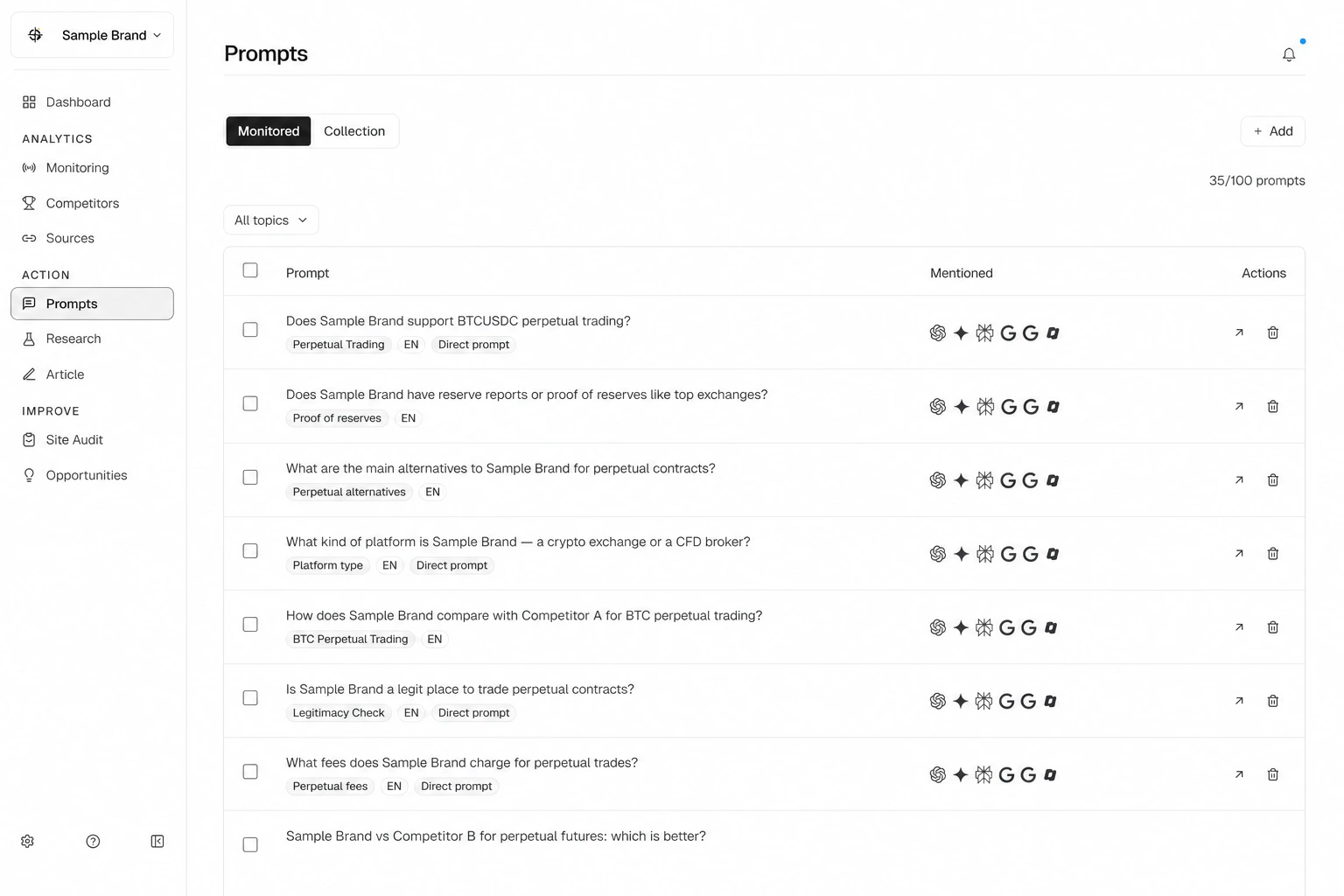
The baseline gives Harborline four different problems, not one vague “visibility is low” conclusion. Some answers need better positioning, some need stronger evidence, and some expose a technical retrieval problem. That distinction determines what the agency sells and which specialist owns the next step.
What happens during the first 30 days
- Days 1–2 — establish the baseline. The strategist confirms the client's brand, competitors, markets, and 25 buying questions. AEO Mantis records whether the brand is mentioned, cited, or absent and stores the answer and sources.
- Week 1 — choose the five highest-value gaps. The account lead reviews the findings with the client. A category prompt tied to new demand ranks above a low-intent definition question, even if both are missing.
- Week 2 — fix retrieval and evidence problems. The technical SEO runs the site audit, removes crawler blockers, and makes important product, trust, and entity evidence easy to retrieve.
- Week 3 — ship the content work. The content lead updates one comparison page, one trust page, and one category guide using the actual claims and sources that appeared in the winning answers.
- Week 4 — re-run and explain the movement. Harborline runs the same 25 prompts again. Mentions move from 9 to 14, cited answers from 3 to 7, and competitor-only gaps from 7 to 4. The agency shows the changed answers and sources without claiming that a single edit caused every movement.
What the client receives each month
The monthly deliverable is not a collection of screenshots. It is a short decision document backed by inspectable evidence:
- Executive summary: what improved, what declined, and what needs a decision.
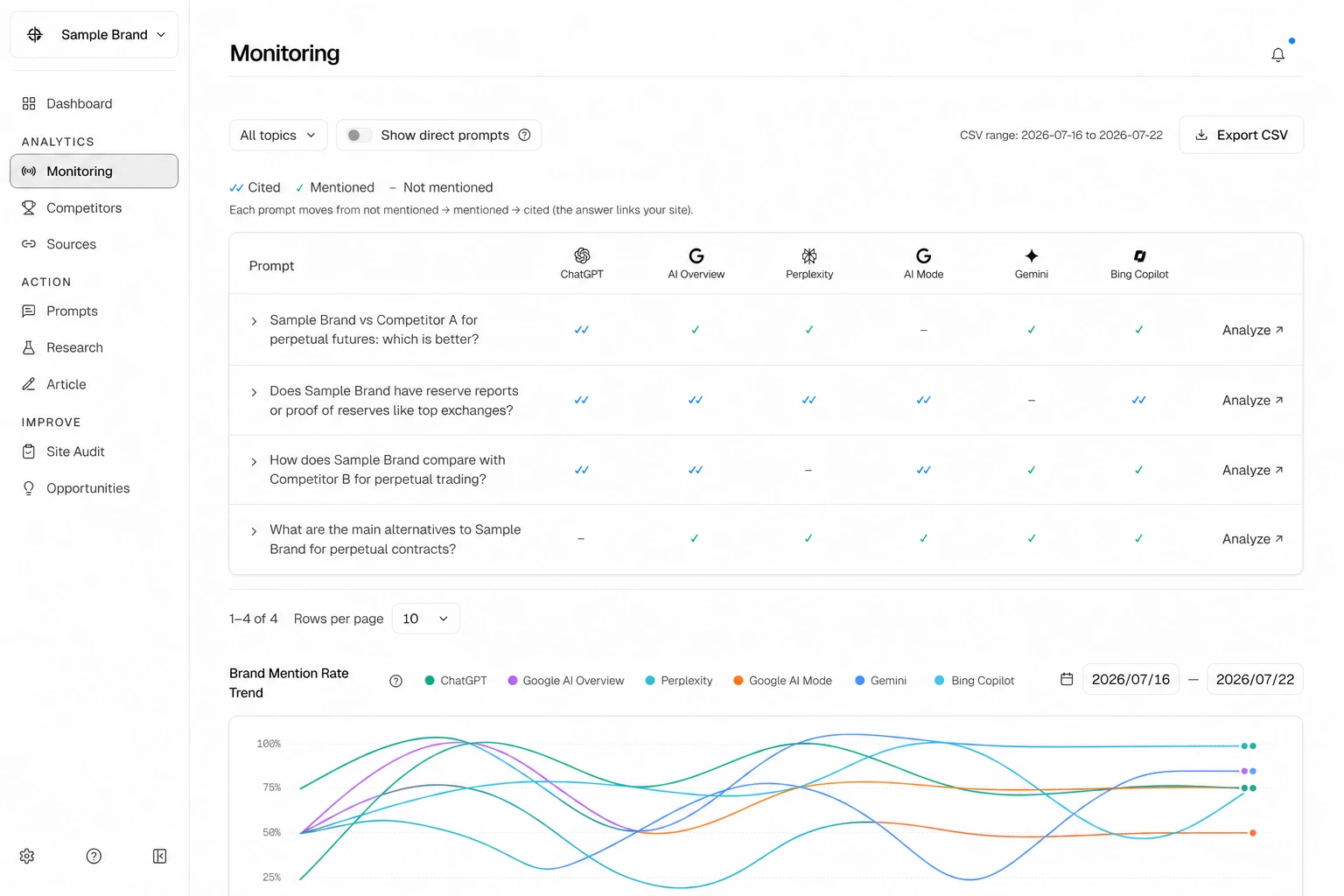
- Prompt scorecard: mention rate, citation rate, and share of voice using the same tracked question set.
- Competitive movement: which competitor gained or lost visibility and on which buying questions.
- Answer evidence: the exact response and cited sources behind every important change.
- Work completed: pages published, technical fixes shipped, and source-authority work performed.
- Next 30-day plan: the three to five actions most likely to close the remaining high-intent gaps.
How each agency role uses the same evidence
| Agency role | When they use AEO Mantis | What they do with the result |
|---|---|---|
| Business development | Before a prospect call | Turn ten buyer questions into a specific visibility audit and pitch |
| Account strategist | During the monthly review | Explain movement, agree priorities, and protect the retainer with evidence |
| SEO and content lead | During sprint planning | Convert competitor-winning prompts into pages, briefs, and on-page updates |
| Technical SEO | When the brand is mentioned but not cited | Check crawl access, rendering, structured evidence, and entity consistency |
| Client lead | When leadership asks about AI search | Show defensible metrics without asking stakeholders to trust a black box |
Three ways to package the service
1. Prospect AI visibility audit
Run a focused set of high-intent prompts before the sales call. Deliver the competitor gaps, cited-source patterns, and a prioritized 30-day plan. The audit makes the first conversation specific and can lead into a wider SEO engagement.
2. Monthly monitoring add-on
Add AI visibility to an existing SEO or content retainer. Maintain one prompt set per client, review trends monthly, and include answer evidence beside organic traffic and ranking movement.
3. Monitoring plus execution
Use the gaps to create the work: comparison pages, category content, source research, entity cleanup, and technical fixes. Re-monitor after each sprint so the client sees a continuous measure–explain–fix–measure cycle.
Why this strengthens an SEO retainer
AI answers create a discovery surface that conventional analytics cannot fully describe. A client can lose a recommendation without losing a tracked ranking or generating a measurable click. AEO Mantis gives the agency a separate measurement layer while reusing skills it already sells: buyer research, competitor analysis, content strategy, technical SEO, and reporting.
Reporting that survives client scrutiny
Every monitored run stores the full answer and cited URLs, so a share-of-voice number is not a black box. The strategist can open the response that produced the metric, explain why the result was classified, and export the data into the agency's existing reporting template. That is what turns AI visibility from an interesting screenshot into a service a client can review every month.
- Each client gets its own prompt set, platform coverage, and competitor list.
- Share of voice, citation rate, and sentiment are all backed by stored answer evidence.
- CSV export pulls metrics and sources into agency reporting templates.
- Content generation and site audit turn findings into sprint-ready content and technical work.
Frequently asked questions
AEO Mantis supports multiple brands per account with per-brand prompt sets, competitors, and monitoring coverage. Brand and seat counts scale by plan tier — see pricing.
Every monitored run stores the full answer and its cited sources. Any metric in a report can be opened to the answer that produced it.
Start with category discovery, direct comparisons, trust questions, integrations, pricing, and the problems the product solves. Prioritize questions close to a buying decision rather than trying to monitor every possible query.
Use the same scheduled cadence you report to the client, usually weekly or monthly. Keep the prompt set and denominator stable so the next result is comparable, and avoid presenting a single movement as proof of causation.
AEO Mantis exports metrics and evidence via CSV for your own reporting templates. The product itself is not white-labeled.