Updated 2026-08-10
AEO Mantis for marketing teams
Marketing teams use AEO Mantis when launching a product, defending a category position, or correcting how AI explains the brand. Track the questions that shape a buyer's shortlist, see the answer and sources behind every movement, assign the right team to each gap, and report AI visibility beside traffic, rankings, and pipeline.
Three decisions this helps a marketing team make
- What should we say? See which product claims and proof points appear in the answers that already win your category.
- What should we publish? Turn missing comparison, trust, and use-case coverage into specific content and PR briefs.
- Did the market response change? Re-run the same buyer questions before and after a launch instead of relying on isolated screenshots.
Scenario: a four-week product launch
Cinder Cloud is launching Sample Product into a crowded B2B automation category. The product marketing lead wants to know whether AI assistants will explain the product accurately, include it in a shortlist, and cite the new proof pages when buyers ask about security and integrations.
Four weeks before launch, the team builds 30 prompts around the full buying journey. The first run reveals a different problem at each stage:
| Buyer stage | Prompt coverage | Baseline finding | Marketing decision |
|---|---|---|---|
| Category discovery | 8 prompts | Sample Product appears in two answers; Competitor A appears in six | Lead the campaign with the category problem and differentiating use case |
| Shortlist and comparison | 8 prompts | The product is mentioned, but its strongest differentiator is missing | Rewrite comparison copy and give sales one consistent proof point |
| Trust and approval | 7 prompts | Security claims appear without a citation to Cinder Cloud | Publish a verifiable trust page and brief PR on the missing source signals |
| Implementation | 7 prompts | Two important integrations are not associated with the product | Strengthen integration pages and launch content around real workflows |
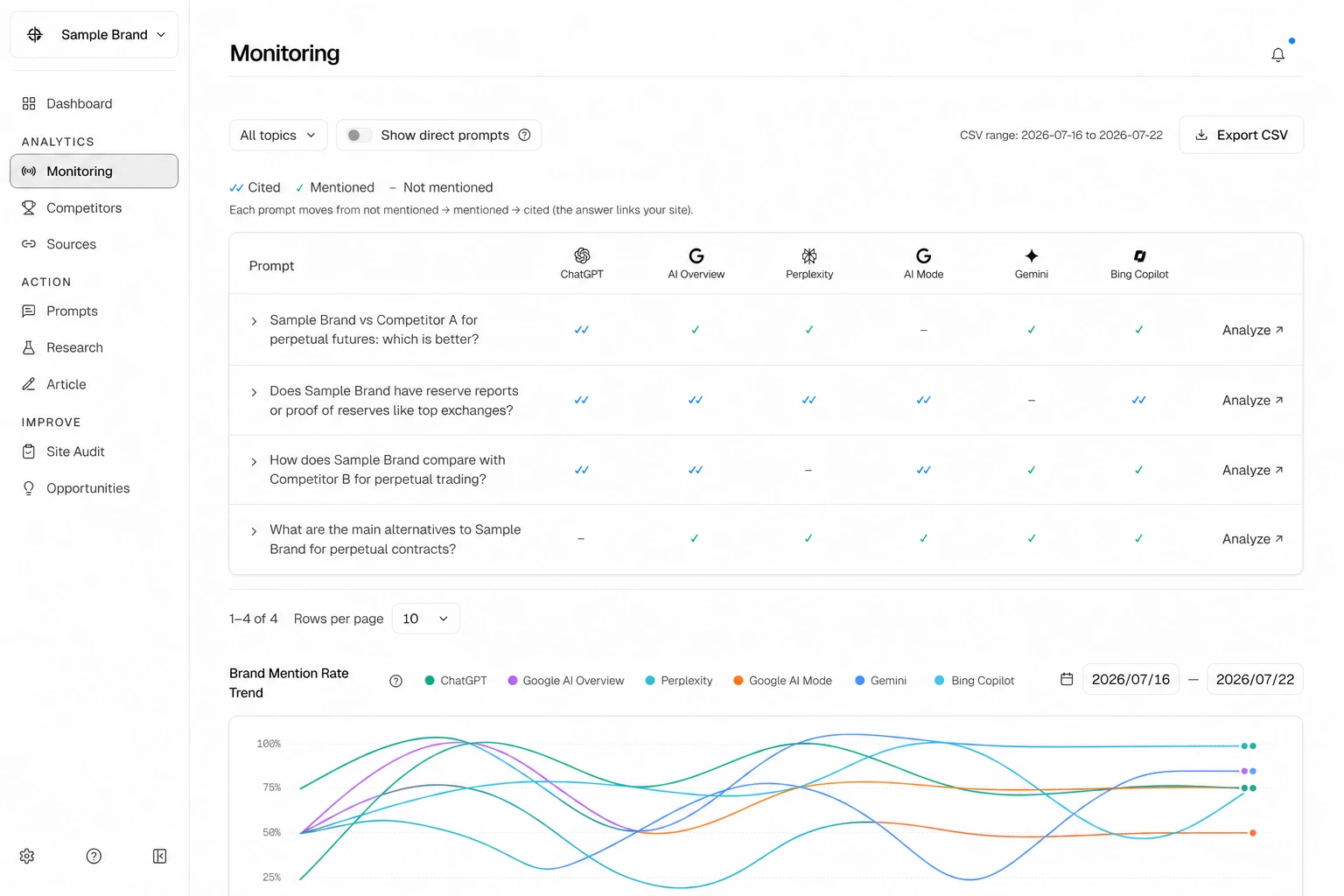
The team now knows that one campaign message will not solve every problem. Product marketing owns the missing differentiation, content owns category and integration coverage, the web team owns the trust page, and PR investigates why third-party sources support competitors more often.
The launch operating rhythm
- Four weeks before launch — establish the baseline. Confirm the product, competitors, markets, and 30 buyer questions. Record mention rate, citation rate, share of voice, and the answer text behind each result.
- Three weeks before launch — align the narrative. Compare the positioning in winning answers with the launch brief. Remove unsupported language, sharpen the differentiator, and give content, PR, sales, and product one evidence-backed message.
- Two weeks before launch — close the proof gaps. Publish the comparison, trust, integration, and use-case pages that buyers and AI systems need to verify the claims.
- Launch week — monitor without changing the measurement. Keep the prompt set stable and run it more frequently. Escalate material changes in recommendations, descriptions, and cited sources.
- Two weeks after launch — report and prioritize. Compare the same 30 questions with the baseline. Cinder Cloud moves from 12 to 19 mentions and from 5 to 10 cited answers; competitor-only results fall from 9 to 5. The team shows the changed answers without presenting the movement as guaranteed attribution.
What appears in the marketing review
The review connects the metric to a decision rather than adding another dashboard:
- Brand discovery: where the product appears before buyers know its name.
- Message accuracy: whether AI answers describe the product, audience, and differentiator correctly.
- Competitive position: which competitors lead each high-intent prompt and why.
- Citation quality: which domains support the answer and whether the brand's own proof is used.
- Work shipped: campaign pages, product updates, PR placements, and technical fixes completed since the last run.
- Next decisions: the three actions, owners, and deadlines for the next reporting cycle.
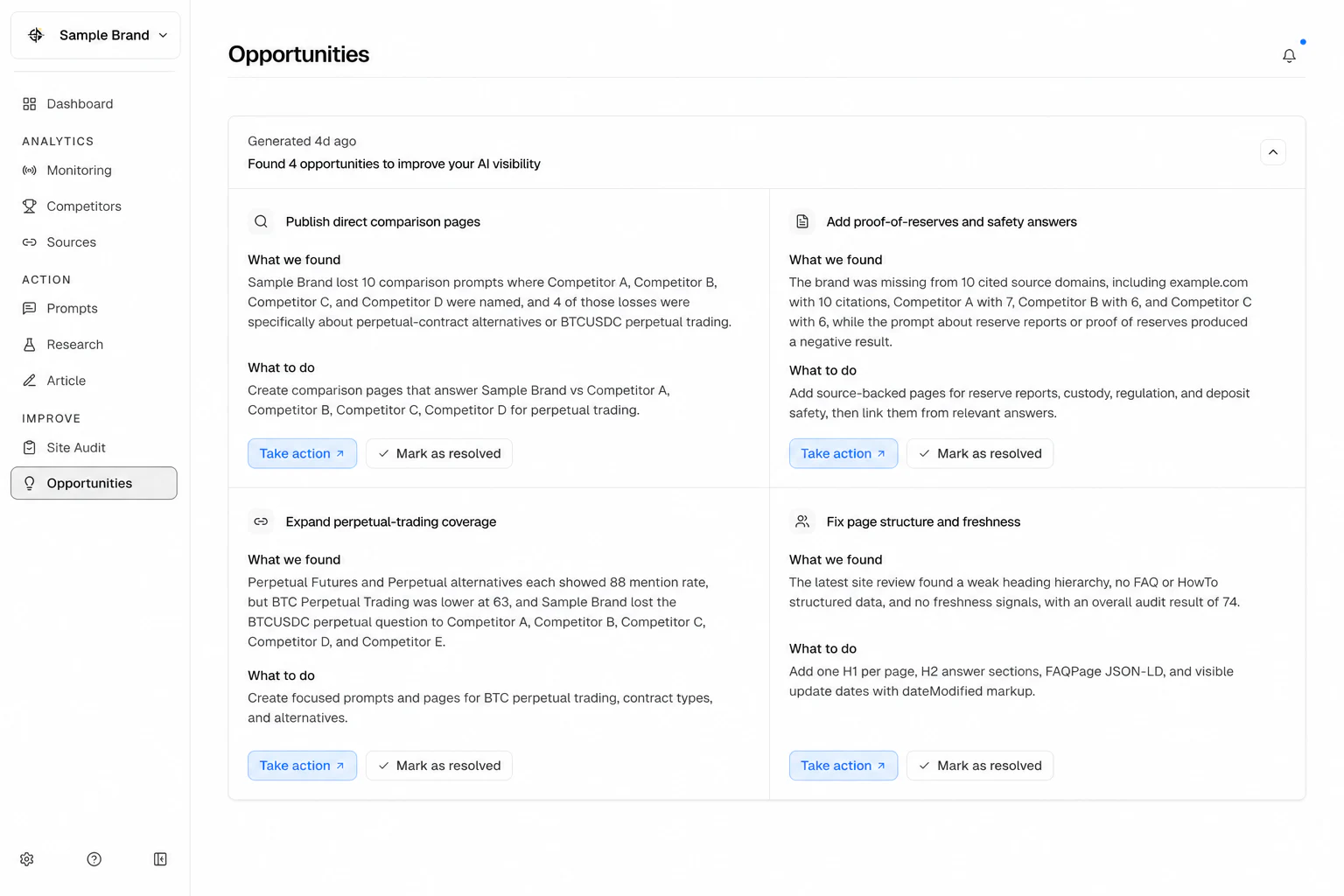
How each function uses the evidence
| Team | Question they need answered | What they do next |
|---|---|---|
| Product marketing | Does the market understand the new product and differentiator? | Align positioning, comparison copy, launch briefs, and sales enablement |
| Content and SEO | Which buyer questions are competitors winning? | Prioritize category, comparison, use-case, integration, and trust content |
| PR and communications | Which third-party sources shape the answer? | Build source authority around claims the brand cannot validate alone |
| Web and technical SEO | Can AI systems retrieve the proof we published? | Fix crawl access, rendering, structure, and entity consistency |
| Marketing leadership | Is AI visibility improving where pipeline is created? | Review trend, investment, ownership, and the next set of priorities |
Other situations beyond a launch
A competitor changes the category narrative
A competitor begins appearing for “best platform for regulated teams” and reframes the category around compliance. The marketing team isolates the affected prompts, reviews the cited sources, and decides whether to challenge the narrative with new proof, reposition an existing page, or leave a low-value claim alone.
AI answers describe the brand incorrectly
The brand is visible, but answers call it an enterprise product when the company is moving down-market. Direct-brand and comparison prompts reveal where the old description persists; product marketing updates canonical pages and watches whether later answers adopt the new positioning.
Leadership asks whether content is influencing AI search
The team maps each published page to the prompts it was intended to influence and reviews the same question set after publication. The result does not replace organic analytics, but it shows whether the brand's presence, citations, and competitive position moved on that separate surface.
AI visibility belongs on the marketing dashboard
Traffic, rankings, and pipeline still matter. AI visibility answers a different question: what buyers are being told before they visit the site, including the recommendations the brand never receives and therefore cannot see in web analytics. Scheduled prompt monitoring makes that surface measurable, while content generation and the site audit turn the gaps into owned work.
- Citation rate and share of voice trend alongside traffic and rankings as KPIs.
- Scheduled monitoring turns anecdotal screenshots into rates with a denominator.
- Every metric is backed by stored answer text and cited sources for stakeholder review.
- Content generation and site audit act on the gaps monitoring uncovers.
Frequently asked questions
Weekly is enough to see trends for most categories; daily makes sense during launches or when a platform is actively shifting. Match cadence to how fast your team can act on the data.
Yes. Paid plans include team seats, and the number scales by tier. See pricing for seat counts per plan.
The prompts you target for AI visibility overlap with your SEO keyword set. Many teams run AEO Mantis alongside their rank tracker — same buyer questions, different surface.
Cover category discovery, direct comparisons, trust and approval, integrations, use cases, and direct-brand questions. Keep the set focused on decisions the launch team can influence.
Treat the movement as directional evidence, not automatic causation. Keep the prompt set stable, inspect the changed answers and sources, and report the work shipped alongside the trend.