Updated 2026-08-10
AEO Mantis for multi-market brands
Multi-market brands use AEO Mantis to separate one global story into local buyer realities. Monitor the questions, competitors, languages, and cited sources that matter in each market; assign the right regional action; and give headquarters comparable reporting without hiding a weak market inside a global average.
Why this is more than translation
The buyer intent can stay constant while the practical question changes. Local terminology, category maturity, buying concerns, competitors, and trusted publications all affect the answer an AI system produces.
| Market | Localized buyer question | What changes in the analysis |
|---|---|---|
| United States, English | “Best workflow platform for distributed retail operations” | National category leaders, integration depth, and enterprise proof |
| Taiwan, Traditional Chinese | 「適合跨店營運團隊的工作流程工具有哪些?」 | Local terminology, regional implementation proof, and Traditional Chinese sources |
| Japan, Japanese | 「複数拠点の業務管理におすすめのツールは?」 | Local category language, domestic competitors, support expectations, and Japanese sources |
A word-for-word translation would make the spreadsheet look consistent while measuring questions buyers may not actually ask. Localized prompt monitoring keeps the commercial intent comparable and lets the wording reflect the market.
Scenario: preparing launches in Taiwan and Japan
Fieldnote Commerce already sells Sample Product in the United States and plans launches in Taiwan and Japan. Headquarters creates one measurement framework—category discovery, comparisons, trust, implementation, and direct-brand questions—then asks each regional lead to localize the prompts, competitor set, and source expectations.
The first review produces three different action plans:
| Market | Baseline finding | What it means | Local action |
|---|---|---|---|
| United States | Sample Brand is cited in 12 of 20 prompts, but Competitor A leads comparisons | The category is established; the gap is competitive proof | Improve English comparison evidence and defend the strongest use cases |
| Taiwan | The brand is mentioned in 7 of 20 prompts but cited twice; local sources dominate | Awareness exists, but regional proof and source authority are weak | Publish Traditional Chinese proof pages and build local corroboration |
| Japan | The brand appears in 3 of 20 prompts and is absent from category answers | The market has a discovery and category-language problem | Validate local phrasing, map domestic competitors, and build a Japanese category page |
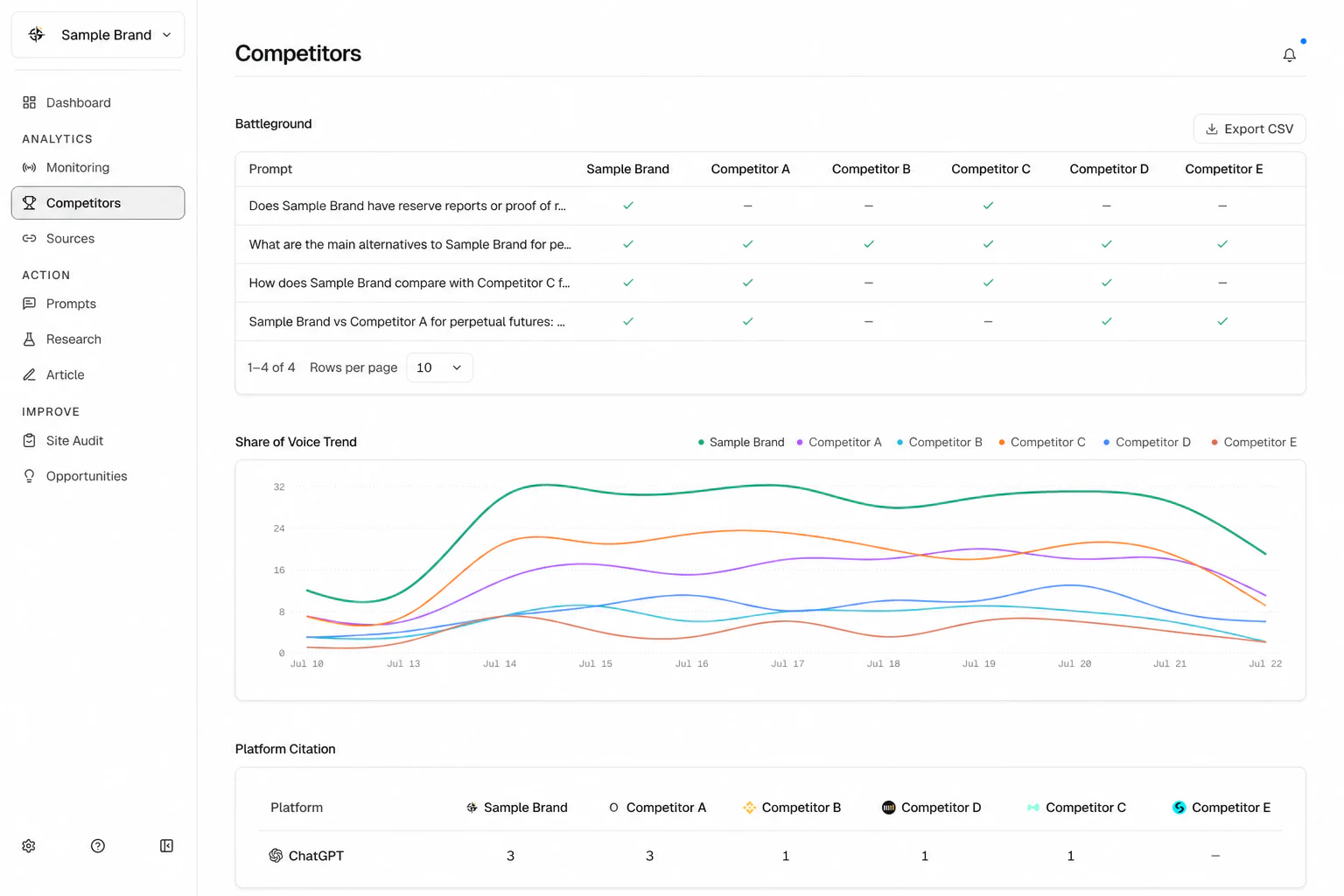
A global average would label Fieldnote “partly visible” and conceal all three decisions. The United States needs stronger comparison proof, Taiwan needs local corroboration, and Japan needs foundational category discovery. Per-market reporting makes the owners and work clear.
A six-week market rollout
- Week 1 — define the common framework. Headquarters chooses the buyer stages and reporting metrics shared across markets. Each region receives the same intent map, not a finished translation sheet.
- Week 2 — localize with market owners. Regional teams rewrite prompts in the language buyers use, replace irrelevant global competitors, and identify trusted local sources.
- Week 3 — establish separate baselines. Run each locale as its own prompt set. Record citation rate, mention rate, share of voice, answer accuracy, competitors, and cited domains.
- Weeks 4–5 — ship market-specific work. The US team improves comparison evidence, Taiwan publishes localized proof, and Japan creates category and use-case coverage. The site audit checks that each localized page can be retrieved.
- Week 6 — re-run and review. Keep each market's prompt set stable. Compare movement inside the market first, then roll the same metrics into a headquarters summary.
What headquarters sees—and what it should not average away
| Reporting layer | Useful view | Decision it supports |
|---|---|---|
| Global summary | Markets improving, stable, or declining; total coverage by platform | Where leadership needs to ask a regional question or change investment |
| Market scorecard | Local citation rate, mention rate, share of voice, and answer accuracy | Whether the regional strategy is moving on its own baseline |
| Prompt evidence | Full answer, cited sources, competitors, and classification | What positioning, content, PR, or technical action is required |
| Work ledger | Pages, campaigns, source work, and technical fixes shipped by market | Who owns the next action and whether it has been completed |
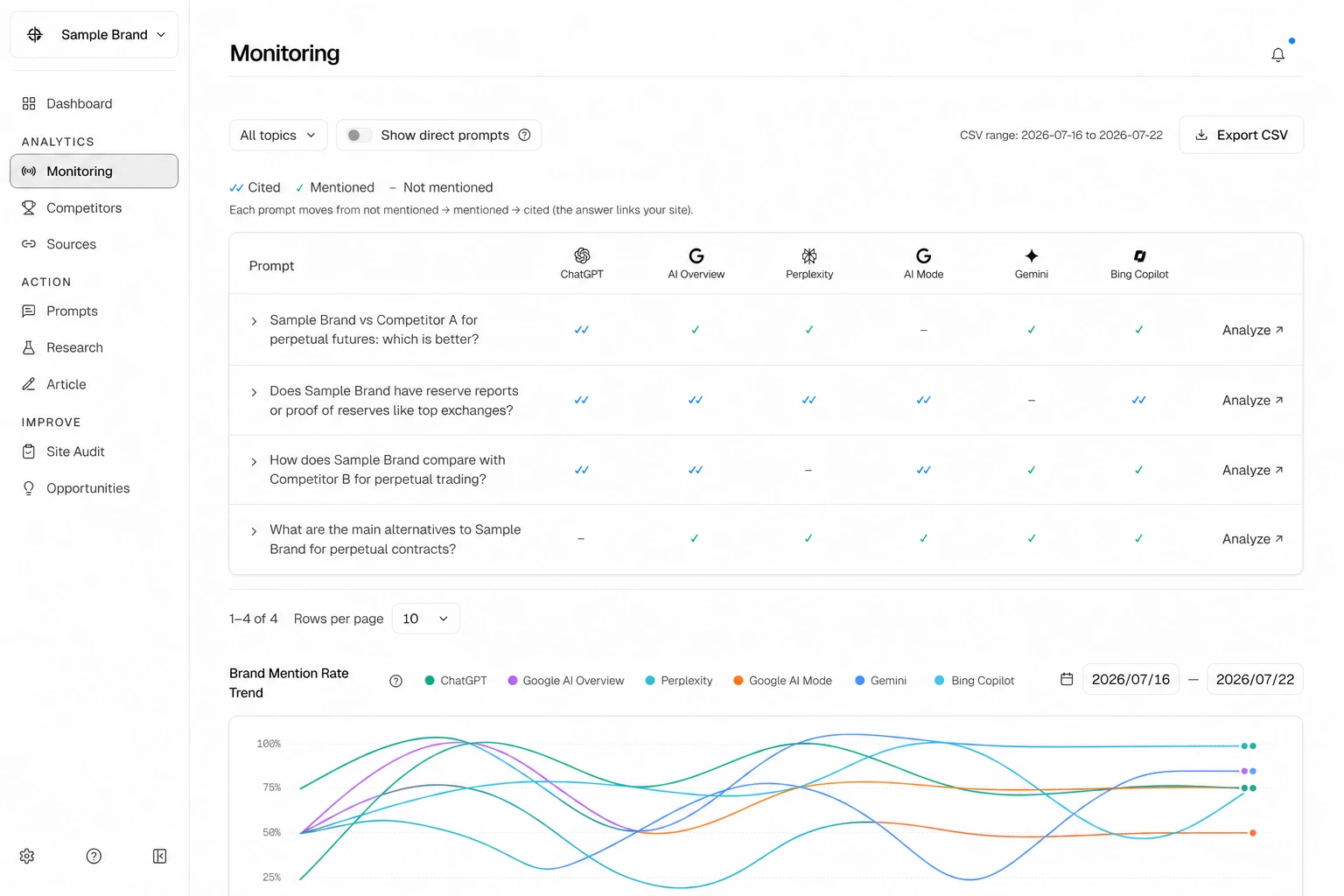
Do not average a strong US citation rate with an absent Japanese category position and call the result “healthy.” The global layer is a navigation tool; the market scorecard is where the diagnosis and work live.
Who owns what
| Owner | Responsibility | Example decision |
|---|---|---|
| Global brand team | Common positioning, entity identity, and reporting definitions | Which claims must stay consistent in every market |
| Regional marketing | Local prompts, competitors, campaigns, and priorities | Whether a missing answer needs local content, PR, or product proof |
| Localization team | Natural buyer language and market terminology | Whether a translated prompt or page matches how the category is discussed locally |
| SEO and web | Localized crawlability, structure, canonicals, and internal linking | Whether AI systems can retrieve and attribute the correct regional page |
| PR and partnerships | Trusted local sources and third-party corroboration | Which regional publications or associations can validate the brand’s claims |
Three situations where market separation matters
Entering a new country
Run the localized baseline before finalizing the launch content plan. If the brand is unknown but the category is mature, build competitive and trust proof. If the category language itself is unstable, validate buyer terminology before creating a large page set.
A local competitor gains visibility
The global brand may look stable while a regional competitor starts winning high-intent prompts. A market-level battleground shows which questions changed and whether the competitor is supported by local sources the global team never tracks.
Rolling out a global rebrand
Direct-brand prompts reveal whether old names, descriptions, and product categories persist in each language. Regional teams can correct the canonical pages and listings that matter locally, while headquarters tracks identity consistency across the rollout.
Why one global number misleads
AI systems can answer the same commercial question differently by language, region, platform, and available sources. The correct operating model is shared definitions with local measurement: one method for comparing markets, separate evidence for deciding what each market needs.
- Each prompt can be targeted to a specific language and region.
- The same brand can be recommended in one market and absent in another.
- Share of voice should be read per region, not averaged into one global number.
- Per-locale monitoring surfaces markets that need targeted content work.
Frequently asked questions
Yes. Create localized prompt variants for each market, so the same buyer question is monitored as buyers in that market experience it.
Platform coverage varies by plan tier. Use pricing for platform availability per plan, and keep market comparisons grounded in the answers each platform returns.
Both, but lead with per-market. A global number that averages a strong market and an absent one hides the work that needs doing. Per-market SOV shows where to focus.
Use the same buyer-intent framework, but let regional teams localize the wording, competitors, and trust questions. Literal translations often produce a clean spreadsheet and a weak measurement.
Compare shared metric definitions and buyer stages rather than forcing identical sentences. Keep each local prompt set stable over time, then compare citation rate, mention rate, and share of voice by market.