Updated 2026-07-06
AI readability site audit
Before an AI engine can cite you, it has to read you. AEO Mantis's site audit crawls your pages the way AI crawlers do and reports what blocks citation: unreachable pages, thin or unliftable content, missing metadata and structure — with concrete fixes, prioritized.
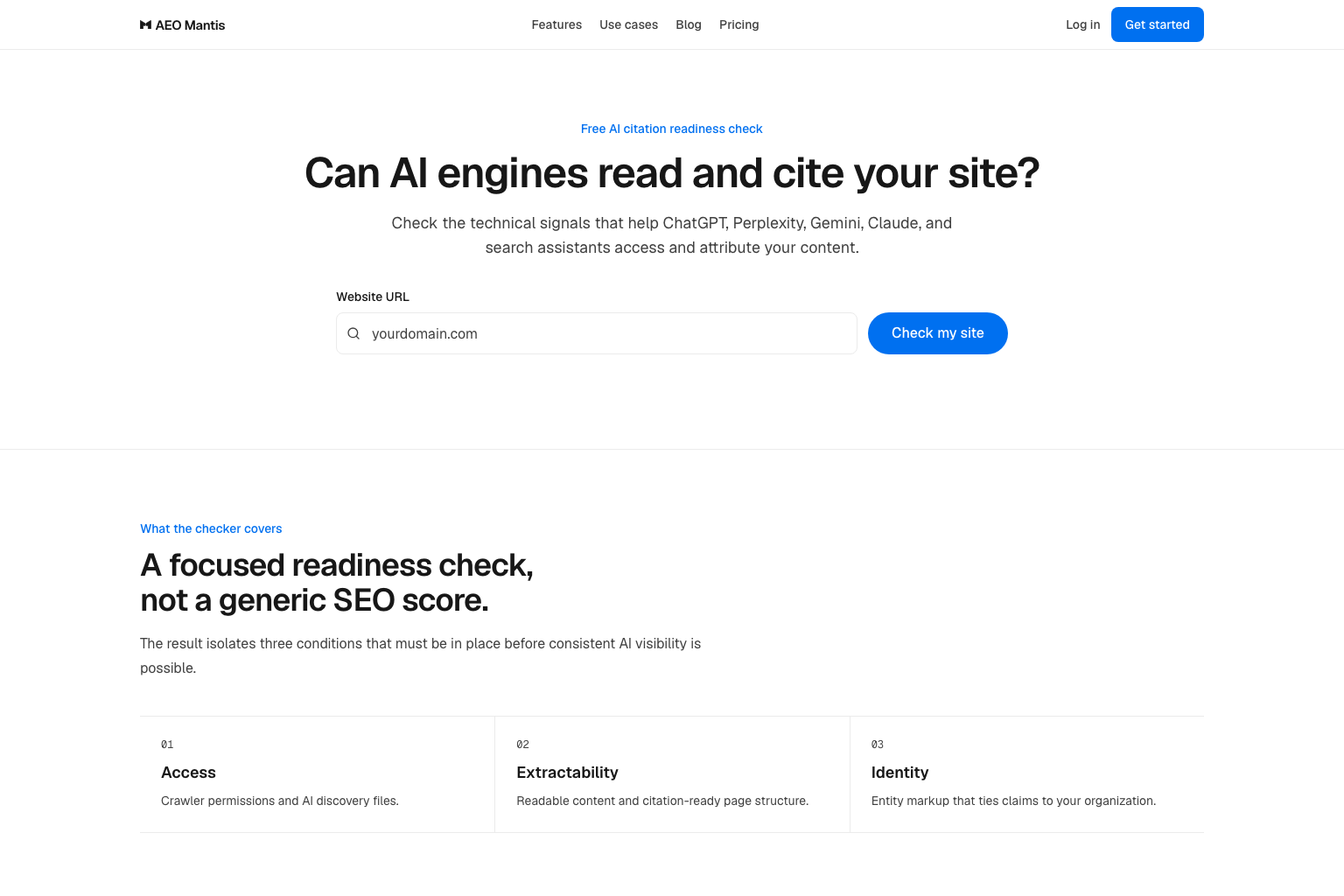
Example: diagnose why example.com is not cited
Sample Brand has a useful product page, but monitored answers never cite it. The audit checks whether AI crawlers can fetch the page, whether the main claims are present in readable HTML, and whether metadata and entity signals connect those claims to the right brand. The result tells the team whether to repair the page before writing anything new.
Step by step
1. Enter the public page you want AI engines to cite
Start with the exact product, comparison, guide, or documentation URL that should answer the monitored question. The checker accepts only public HTTP(S) targets and applies bounded fetching and timeouts.
2. Review access, extractability, and identity
Access checks crawler permissions and discovery files. Extractability checks whether the important content is available without fragile client rendering. Identity checks whether the page ties its claims to the organization clearly enough for attribution.
3. Prioritize the highest-impact failure
Fix retrieval blockers before rewriting copy. Then address missing answer-first sections, metadata, structured data, or unsupported claims. The score orders the work; the individual finding explains it.
4. Move the finding into the work queue
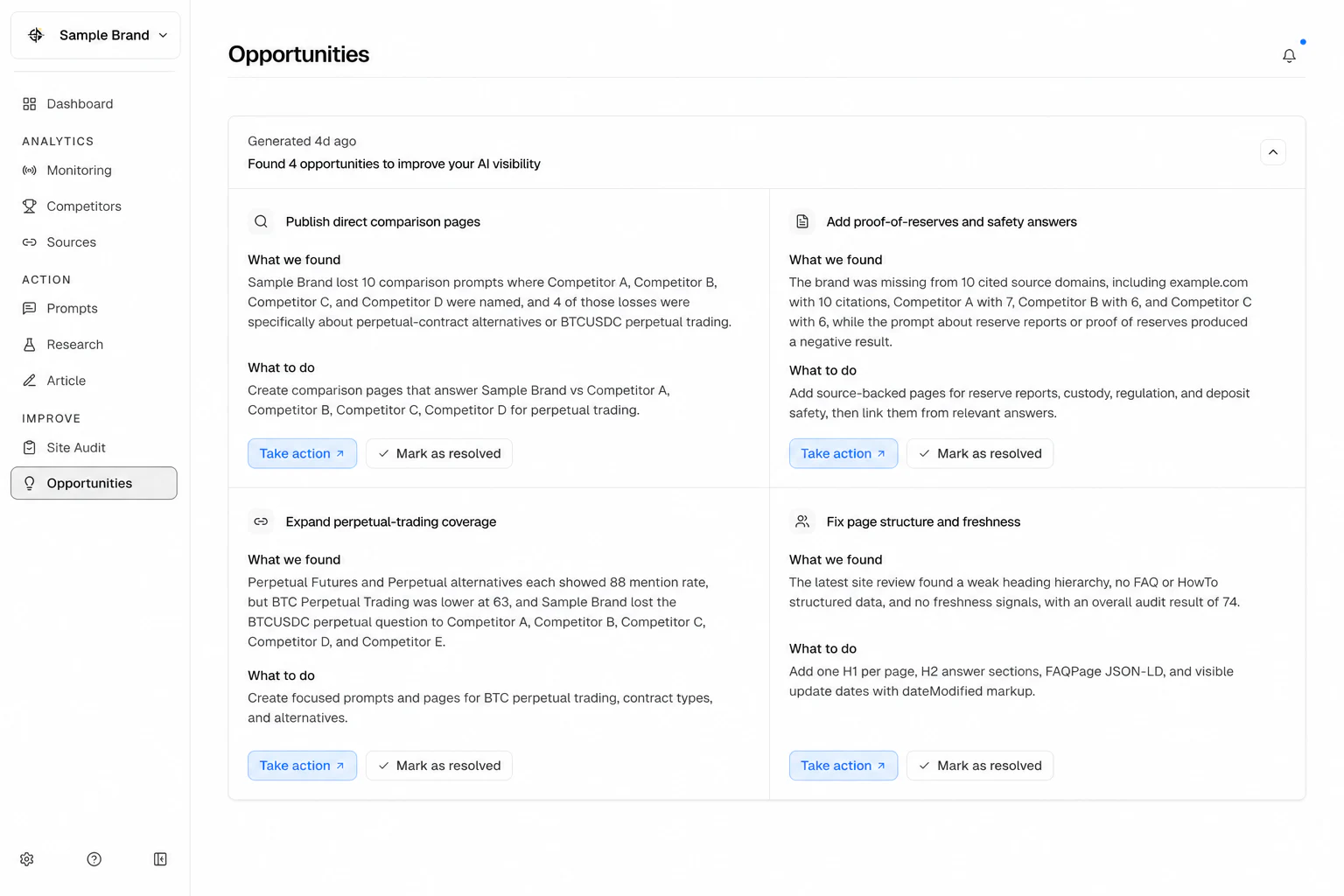
Audit findings feed Opportunities with both the evidence and the recommended repair. When the correct fix is new content, the same item can open the content workflow without losing the original diagnosis.
Why AI readability is its own problem
AI crawlers are less forgiving than Googlebot: many don't execute JavaScript, give up faster, and quote only what's plainly in the HTML. A page that ranks fine in classic search can still be invisible to answer engines — client-rendered content, blocked bots, or key claims buried in interactive components all read as empty pages to a retriever.
What the audit checks
- Reachability — can crawlers actually fetch your key pages: status codes, redirects, robots rules, response times.
- Content structure — headings that match questions, answer-first sections, liftable claims versus walls of prose.
- Metadata and structured data — titles, descriptions, and the schema that helps engines classify your pages.
- Citability — whether pages state the direct, specific facts an engine can quote (citation mechanics).
Audits run at a configurable depth and page budget, and results are scored so the highest-impact fixes surface first.
Use content generation only when the diagnosed fix is a new page or section rather than a technical repair.
- Crawls with strict safety and timeout discipline — only public HTTP targets, politely.
- Scores findings by impact so fixes are prioritized, not just listed.
- Depth and page budget are configurable per audit run.
- Results connect to Opportunities and content generation for the fix itself.
Frequently asked questions
The lens is AI retrieval: JavaScript-dependence, liftable claims, and answer-first structure matter more; some classic ranking factors matter less. Run both — they overlap but don't substitute.
No — audits fetch a bounded number of pages with timeouts and rate discipline, and only ever public HTTP(S) URLs.
You choose depth and page budget per run, within plan limits.