Updated 2026-08-18
Best AI visibility tools in 2026: how to choose the right platform
The best AI visibility tool is the one that fits the decision your team needs to make. Shortlist AEO Mantis when a lean team wants monitoring, audits, research, and content action in one workflow; Profound for a broad enterprise AEO program; Ahrefs Brand Radar for large-scale market discovery; Semrush for AI visibility inside an established SEO stack; Peec AI for prompt, competitor, and source analysis; and OtterlyAI for focused monitoring. Test every option with the same prompts, platforms, locale, and region before comparing results.
AI visibility tools measure whether a brand appears, earns citations, and gets recommended when buyers ask ChatGPT, Gemini, Perplexity, Google AI experiences, Copilot, and other answer engines about a category. The category is moving quickly, but the buying problem is stable: a dashboard is only useful when the team can trace a metric back to the prompt, answer, and source that produced it.
This guide compares six platforms by workflow rather than declaring one universal winner. Capabilities were checked against each vendor's public product pages and documentation on August 17, 2026. Pricing, platform coverage, and limits change, so verify them during a trial or sales review.
Disclosure: This guide is published by AEO Mantis. No vendor paid for inclusion, and every product was assessed using the same evidence and workflow criteria.
The best AI visibility tools at a glance
| Tool | Shortlist it when | Publicly documented strengths | What to verify |
|---|---|---|---|
| AEO Mantis | A lean team wants to move from monitoring evidence to a technical or content action without assembling several products | Custom prompt monitoring, saved answers and citations, separate mention and citation metrics, competitor context, site audits, research, opportunities, and content workflows | That its included platforms, prompt allowance, and reporting cadence match your market panel |
| Profound | An enterprise program needs prompt-demand research, answer-engine measurement, crawler analytics, and automated content workflows | Prompt Volumes, Answer Engine Insights, server-log Agent Analytics, competitive benchmarks, and content Agents | The implementation, governance, and plan scope required for the modules your team will actually use |
| Ahrefs Brand Radar | You want broad market discovery across a large search-backed prompt database before narrowing to a custom tracking panel | Large indexed datasets across seven AI platforms, brand and competitor research, cited pages and domains, cross-channel sources, and custom prompts | Whether its indexed prompt universe or your own custom prompts should be the primary baseline |
| Semrush AI Visibility Toolkit | Your team already works in Semrush and wants AI visibility connected to prompt research, competitor analysis, and site auditing | Brand benchmarking, prompt research and tracking, competitor gaps, sentiment, cited sources, regional data, and AI-focused site checks | The domains, locations, tracked prompts, exports, and user access included in the selected toolkit |
| Peec AI | Your weekly review centers on exact prompts, competitor movement, brand position, sentiment, and the sources influencing answers | Daily prompt runs, visibility and position trends, competitor comparisons, source analysis, recent answer inspection, and action suggestions | Model, country, language, export, and integration coverage for your reporting workflow |
| OtterlyAI | A smaller team or agency wants a focused monitoring product with prompt research, brand reports, and citation tracking | Prompt monitoring, brand and domain reports, citation tracking, competitive visibility, and coverage across six named AI search surfaces | Whether the research and optimization depth is sufficient beyond the core monitoring workflow |
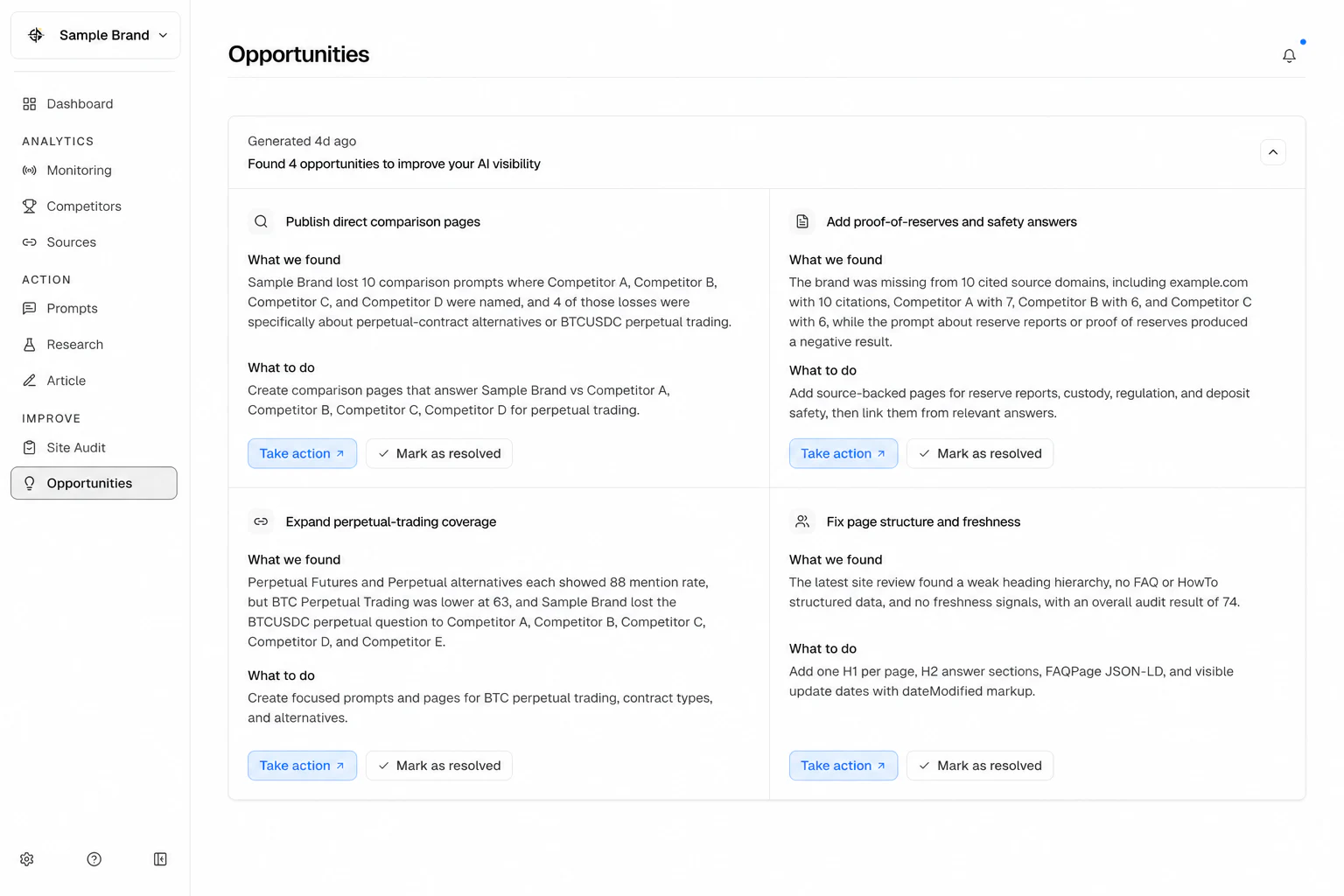
These are not interchangeable scoreboards. Ahrefs emphasizes market-scale discovery, while prompt trackers emphasize a panel you define. Profound combines answer-engine data with server-log analytics and automation. Semrush connects AI reporting to a wider SEO suite. AEO Mantis connects monitoring evidence to audits, research, and a content work queue. The correct choice depends on which of those jobs your team must complete each week.
How we evaluated the tools
A useful comparison starts with the evidence needed to reproduce a result. We used eight requirements that cover the path from measurement to action.
| Requirement | Why it matters | Question to ask in a trial |
|---|---|---|
| Prompt control | Keeps buyer questions stable and separates discovery from direct-brand checks | Can we preserve the exact prompt, topic, locale, region, and inclusion rule? |
| Full answer evidence | Makes a chart movement traceable to the answer that caused it | Can we open successful, missing, citation-free, and failed answers? |
| Separate visibility metrics | Prevents mentions, citations, recommendations, position, and sentiment from becoming one vague score | Can we inspect the numerator and denominator behind every headline metric? |
| Platform and market controls | Shows where performance differs instead of averaging unlike answer engines and regions together | Can we filter and export each platform, language, country, and date range separately? |
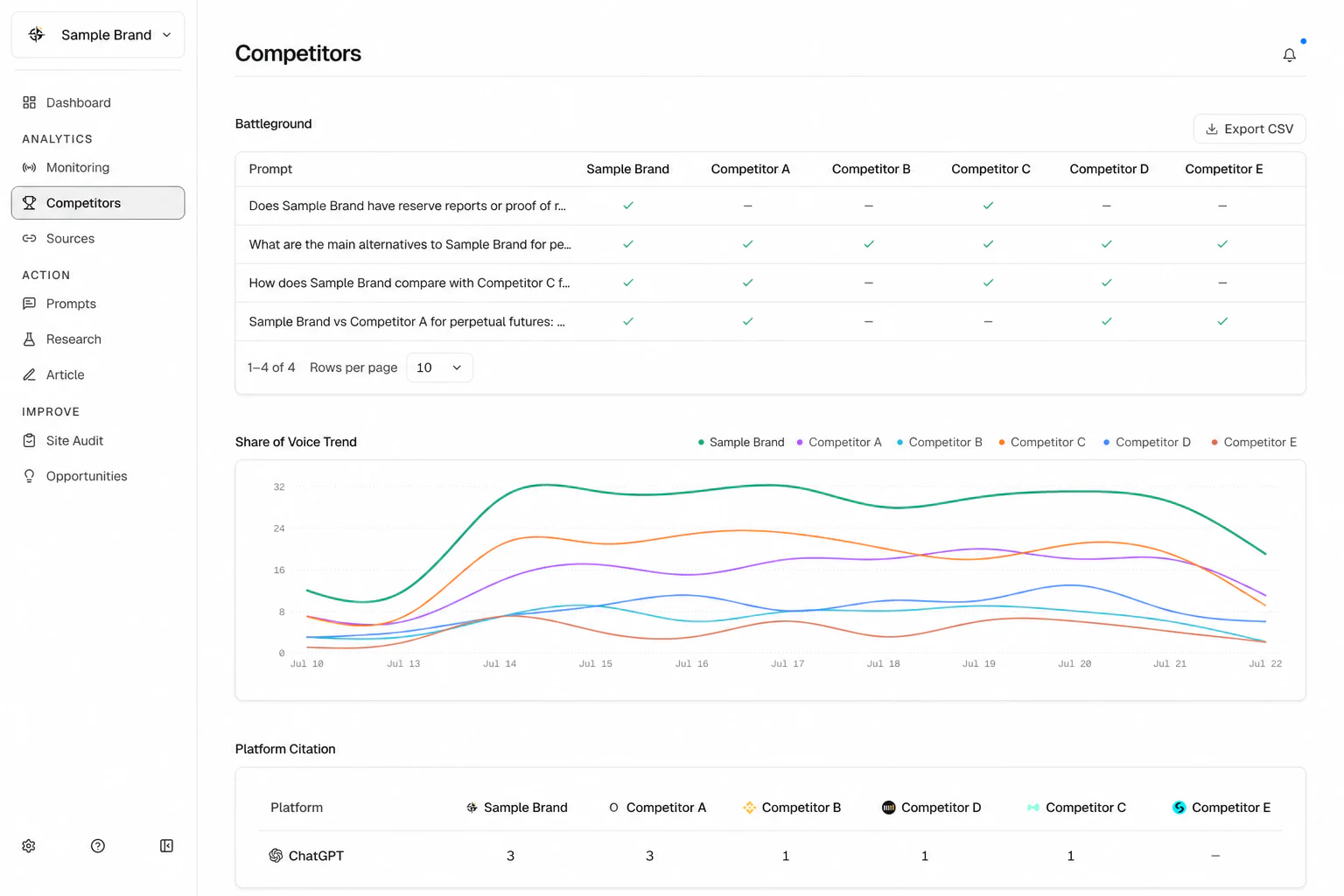
| Competitor context | Reveals who earns the mentions and citations the brand misses | Can we open the exact prompts and sources where a competitor wins? |
| Technical diagnostics | Finds crawl, rendering, metadata, and entity issues before a content rewrite | Does the product test the page or only report answer-level outcomes? |
| Opportunity prioritization | Turns missing visibility into an ordered work queue | Can a finding become an owned action with a page, reason, and measurement window? |
| Research and content workflow | Connects a losing answer to a source-backed page that can compete for the citation | Can we carry the evidence into a refresh without losing the original prompt and source? |
Raw platform count is a weak buying criterion. Coverage matters only when each run preserves enough evidence to support the next decision. A product that tracks more engines but hides the answers may be less useful than a smaller, defensible panel.
Which AI visibility tool fits each use case?
AEO Mantis: measure-to-action workflow for lean teams
AEO Mantis is designed for teams that want one operating loop: define prompts, capture answers and citations, compare competitors, diagnose technical or content gaps with a site audit, research the issue, and create the next action. Included answer surfaces vary by plan, and results stay separate by platform. Free starts with an onboarding scan across five ChatGPT prompts for one brand.
The differentiator is not a proprietary universal score. Prompt scope is controllable, mentions and citations remain separate, and the underlying answer evidence stays available. That makes it possible to explain why a metric moved and decide whether the next step belongs in a site audit, an existing-page refresh, or a new content brief.
Profound: broad enterprise AEO operations
Profound combines several enterprise AEO workflows in one suite. Its public platform includes real-user prompt-demand data, daily answer-engine visibility and citation analysis, server-log crawler and referral analytics, and configurable content Agents. That makes it relevant when different enterprise teams own research, analytics, infrastructure, and publishing.
The buying question is scope. A team that needs only a small tracked prompt panel may not need every module. Ask which integrations, controls, implementation work, and data access are included in the proposed plan.
Ahrefs Brand Radar: large-scale discovery
Ahrefs Brand Radar is built around a large search-backed prompt index across seven AI platforms, with custom prompt tracking available alongside the index. It is useful for exploring a market without waiting for a newly configured panel to accumulate history, comparing brands at scale, and connecting AI mentions and citations with web, Reddit, YouTube, and TikTok visibility.
Its indexed data and a custom prompt panel answer different questions. Use the index to discover demand and competitors; use stable custom prompts to measure the exact buyer questions your team owns.
Semrush AI Visibility Toolkit: AI data inside an SEO suite
Semrush is a practical shortlist choice for teams already using its SEO workflows. The AI Visibility Toolkit combines brand benchmarking, prompt research and tracking, competitor and sentiment analysis, cited-source opportunities, regional data, and AI-focused site-audit checks.
Verify the operational limits rather than assuming an existing Semrush subscription includes everything. Domains, locations, prompt counts, exports, and user access vary by toolkit and plan.
Peec AI: prompt, competitor, and source analysis
Peec AI centers the workflow on daily prompt runs and the relationships between visibility, average position, sentiment, competitors, and cited sources. Teams can inspect recent answers, see which sources influence the category, and identify topics where competitors are visible but the tracked brand is absent.
This is a strong fit when the weekly meeting starts with specific prompt and source movements. Confirm the markets, languages, models, and integrations required by your team before treating one project as a global benchmark.
OtterlyAI: focused monitoring for teams and agencies
OtterlyAI offers prompt research, daily search-prompt monitoring, brand reports, citation and domain tracking, and competitor visibility across ChatGPT, Google AI Overviews, Perplexity, Google AI Mode, Gemini, and Microsoft Copilot. Its focused product shape makes it approachable for agencies and smaller marketing teams that primarily need monitoring and reporting.
During a trial, test the step after detection. If your team also needs technical diagnosis, research, or a production content workflow, confirm whether OtterlyAI's optimization features cover that depth or whether another system will own the action.
How should you test an AI visibility tool?
Run a small, fixed pilot that represents real buyer decisions. Fifteen to twenty prompts are enough to expose workflow gaps without turning evaluation into a quarter-long project. Cover category discovery, use-case fit, comparison, implementation, pricing, risk, and trust.
Use the same prompt wording, platforms, locale, region, cadence, and scoring rules for at least seven days. With 20 prompts across three engines, that produces up to 420 prompt-engine-day observations. AI answers vary, so these are not perfectly independent statistical samples; they are a practical test of repeatability, missing runs, evidence capture, and trend handling.
Complete the same five tasks in every product:
- Open a prompt where the brand was absent and identify the brands and sources that won.
- Open a prompt where the brand was mentioned but its domain was not cited.
- Separate a direct-brand prompt from discovery metrics without deleting its answer.
- Trace a chart movement back to the exact answers that caused it.
- Turn one loss into an assigned action, then find it again during the next review.
If a product cannot complete this loop, another summary chart will not make it operational.
Which metrics should survive a tool switch?
Measurement definitions should remain portable even when software changes. At minimum, preserve the prompt text, topic, intent class, platform, locale, region, run time, full answer, detected brands, visible citations, and whether the prompt counts toward headline metrics.
From that evidence, AI visibility metrics remain understandable:
- Mention rate: qualified answers that name the brand divided by qualified answers run.
- Citation rate: qualified answers that cite the brand's domain divided by qualified answers run.
- Share of voice: brand mentions as a share of mentions across the defined competitive set.
- Average position: where the brand appears among named options, using a documented counting rule.
- Sentiment: how answers that mention the brand frame it, inspected with the underlying text.
- Recommendation rate: answers that present the brand as a fit, tracked separately from a passing mention.
Exported percentages without prompt and answer evidence are not a migration path. They are a snapshot of a methodology the team cannot reproduce.
What should you verify before choosing a plan?
Start with failure modes that would make the data unusable. Can the product distinguish visible citations from pages accessed in the background? Does it preserve citation-free or failed answers instead of dropping the row? Can the team correct brand aliases without rewriting history? Can regions and languages remain separate? Does a prompt edit create a clear break in the trend?
Then test the human workflow. Ask the weekly-review owner to complete the review without assistance. Ask the content owner to open one losing answer and identify the page to change. Ask a stakeholder to reproduce a chart number from saved answers. Those tasks measure adoption more honestly than a feature checklist alone.
Finally, calculate the real unit cost. Prompt limits hide the multiplier: prompts × platforms × regions × run frequency. Choose a plan for the panel the team will maintain, not the largest panel shown during onboarding. AEO Mantis's pricing makes that progression explicit, beginning with a free onboarding scan across five ChatGPT prompts.
- Twenty prompts across three platforms create 60 answer observations per run, so prompt limits must be evaluated with platform and region multipliers.
- A brand mention, domain citation, recommendation, and position are different events and should not be collapsed into one score.
- Direct-brand prompts can overstate discovery performance when they count toward headline Mention Rate.
- A defensible trend keeps the prompt, platform, locale, region, cadence, and scoring rule stable.
- The best tool is the one that turns answer evidence into the next owned action for your actual team.
Frequently asked questions
A practical shortlist includes AEO Mantis, Profound, Ahrefs Brand Radar, Semrush AI Visibility Toolkit, Peec AI, and OtterlyAI. They serve different workflows, so compare them using the same prompts, platforms, locale, region, and evidence requirements.
Look for prompt control, saved answer evidence, separate mention and citation metrics, platform and market filters, competitor context, source analysis, exports, and a clear path from a visibility gap to an owned action.
Start with 15 to 20 prompts covering distinct buyer decisions and run the same set across the same platforms, locale, and region for at least seven days.
Yes, for a small pilot. Save every prompt, answer, platform, date, brand mention, and citation in a spreadsheet. Software becomes valuable when repeated runs, multiple platforms, evidence retention, and team reporting become difficult to maintain.
A question that already names the brand makes a mention structurally likely. Keep those answers for accuracy and sentiment review, but separating them prevents discovery metrics from receiving easy credit.