Updated 2026-09-10
AI brand mentions: How to track them in AI search
AI brand mentions are appearances of your company or product in generated answers, whether or not the answer links to your site. Track them by running a stable set of buyer prompts, preserving each full answer and visible source, then separating mentions from citations, recommendations, sentiment, and competitor share of voice. Use short windows to investigate changes and complete longer periods for direction. The goal is an auditable path from an observed answer to one owned action—not a single visibility score.
Traditional brand monitoring watches news, websites, reviews, and social posts for a name. AI brand monitoring watches generated answers. That changes the unit of evidence: one prompt, on one platform, at one time, with the answer and its visible sources preserved.
This matters because an AI answer can name your brand without linking your site, cite your content without recommending you, place competitors ahead of you, or describe you negatively. A useful monitoring system keeps those events separate instead of collapsing them into one flattering number.
To connect answer visibility with measurable visits and outcomes, use the GA4 guide to AI referral traffic. Keep citation evidence and session attribution separate.
What AI brand monitoring measures
AI brand monitoring answers four different questions:
- Are we present? Brand mention rate is the share of qualified answers that name the brand, whether or not they link to it.
- Are we a source? Citation rate is the share of qualified answers that link the configured domain as a source.
- Are we winning the category conversation? Share of voice compares your appearances with those of a fixed set of tracked competitors.
- How are we framed? Sentiment and recommendation status help distinguish useful visibility from neutral, negative, or disqualifying appearances.
These metrics describe observed answers, not market share, search rank, traffic, or revenue. They become useful when the scope is stable and the underlying answer remains available for inspection.
How to track AI brand mentions step by step
Use the same six-step loop for every reporting period:
- Define the scope. Fix the buyer prompts, platforms, locales, brand aliases, owned domains, and competitor set.
- Collect complete answers. Save the prompt, platform, run time, full response, and every visible source URL.
- Classify each result. Record a brand mention separately from an owned-domain citation, recommendation status, sentiment, and competitor appearances.
- Calculate transparent rates. Show the numerator and qualified-answer denominator beside mention rate, citation rate, and share of voice.
- Inspect the evidence. Open the answers and cited pages behind gains or gaps before assigning a content, technical, brand, or PR action.
- Measure again under the same conditions. Annotate scope changes and compare complete periods instead of treating one generated answer as a trend.
This process turns AI brand mentions into auditable observations. It does not assume that every mention is favorable, that every citation is an endorsement, or that a visibility change caused traffic or revenue.
Build a monitoring scope that can be compared
The prompt set is the denominator for every headline metric. Start with real buyer language from sales calls, support questions, Search Console queries, reviews, and site search. Then turn those themes into questions where the answer could change a shortlist.
A balanced set covers several moments:
- Problem recognition: “How can I tell whether AI assistants mention my company?”
- Category discovery: “Which AI visibility tools suit a small B2B team?”
- Comparison: “Which platform tracks citations separately from brand mentions?”
- Fit: “Can this tool monitor several markets and competitors?”
- Risk: “How can I verify the answers behind an AI visibility report?”
Keep direct-brand questions such as “What is Sample Brand?” for accuracy checks, but do not mix them into discovery metrics by default. The user already supplied the brand name, so those prompts are easier to win. Use the method in How to Find the Buyer Prompts Your Customers Ask AI to build a stable core set.
Define the rest of the scope before the first baseline:
- canonical brand name, common aliases, and the domain that counts as your own;
- markets and languages, kept as separate prompt sets when buyer language differs;
- AI platforms to monitor;
- competitors included in share of voice;
- inclusion rules for direct-brand, competitor-only, and failed answers;
- reporting windows and the minimum answer count shown beside any rate.
If the prompt, platform, competitor, or exclusion scope changes, annotate the change. Otherwise a dashboard movement may be a measurement change rather than a market change.
Establish the baseline before optimizing
Run the same prompt set on a schedule before making changes. A single answer is evidence of what happened once; it is not a trend.
For every qualified check, preserve:
- prompt, platform, locale, and run time;
- full answer text;
- whether the brand was mentioned;
- whether the configured domain was cited;
- competitors that appeared;
- visible source URLs;
- sentiment and recommendation context;
- errors or missing answers that affect the denominator.
The baseline should show both the rate and the count behind it. A move from one mention in five answers to two in five looks like a 20-point gain, but the sample is still five answers. Counts keep small samples honest.
Read mentions and citations together
Mentions and citations diagnose different problems.
- High mentions, low citations: AI systems know the brand, but your site is rarely used as evidence. Inspect crawler access, the clarity of the relevant page, answer-first passages, and whether a stable URL supports the claim.
- Low mentions, healthy citations: your content can earn source slots, but the brand is not entering the shortlist. Inspect category positioning, entity consistency, and third-party corroboration.
- Both low: confirm prompt fit and technical access before producing more content.
- Both rising: check whether the gain occurs on unbranded buyer prompts and whether recommendation context also improved.
A citation is not automatically an endorsement. It may support a generic fact while another brand receives the recommendation. Likewise, a mention does not prove that the AI system used your website. Open the answer and sources before deciding what to change.
Add competitors to make share of voice actionable
Share of voice needs a defined competitive set. Keep that list stable and report it beside the number. Adding or removing competitors changes the denominator, so the new percentage is not directly comparable with the old one.
The useful view is not only the trend line. Open the “battleground” prompts where a competitor appears and your brand does not. For each gap, ask:
- Which competitor was named or cited?
- What claim or category association earned the placement?
- Which sources supported the answer?
- Does your site contain a stronger, current, directly answerable page?
- Is the missing signal on your site, in third-party coverage, or in brand/entity clarity?
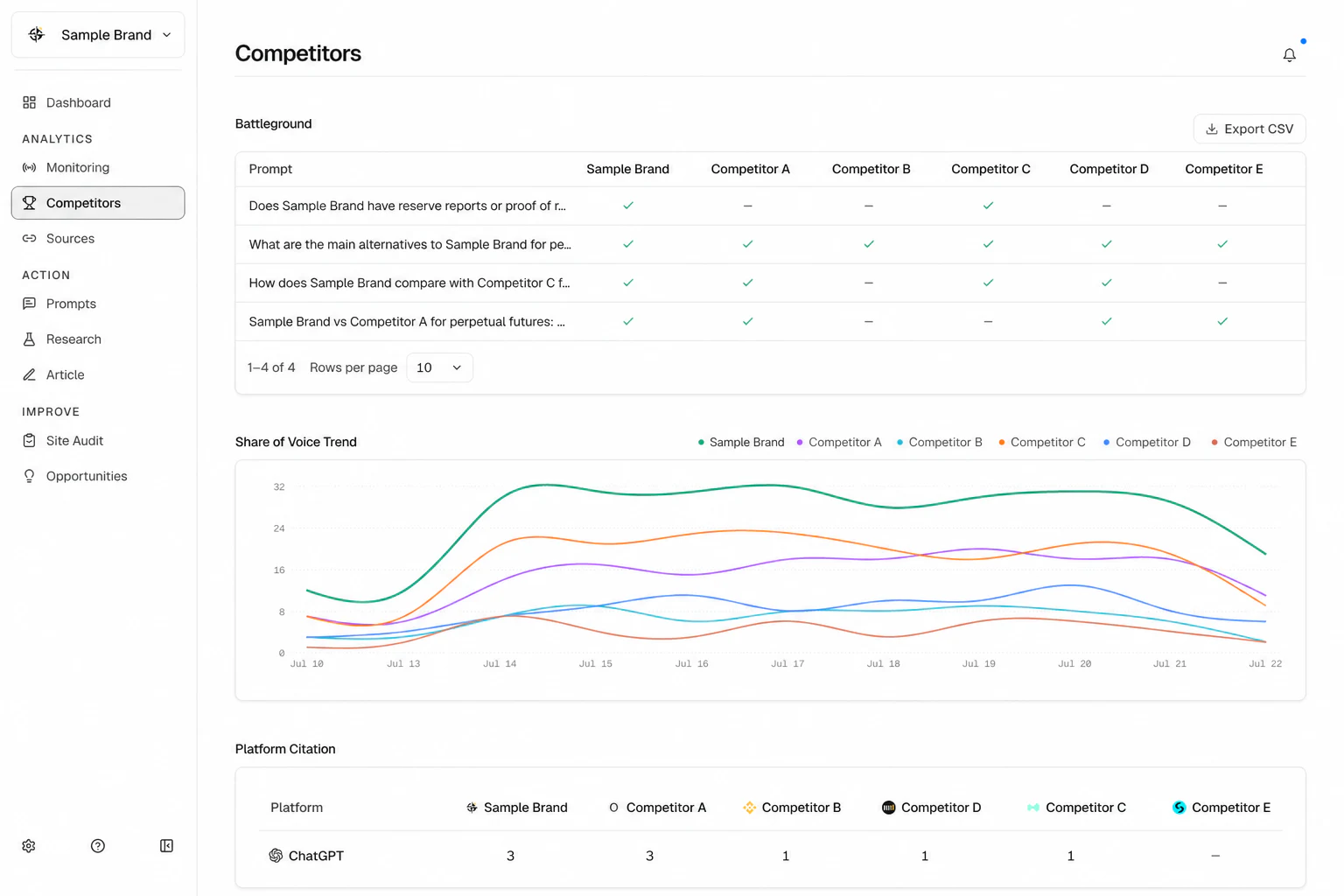
This is where AI brand monitoring differs from passive mention counting: it turns a competitive absence into a question the content, technical, brand, or PR team can investigate.
Turn each gap into one owned action
Do not respond to every missing mention by publishing a new article. Choose the smallest lever that matches the evidence.
- The right page exists but is not cited: improve crawl access, answer structure, facts, internal links, and source clarity on that URL.
- No page answers the buyer question: create one focused page that gives a direct answer and supports it with verifiable detail.
- The brand is described inconsistently: align the official name, product category, descriptions, organization markup, and trusted profiles.
- Competitors are supported by stronger third-party evidence: pursue relevant coverage, reviews, directories, or expert references without fabricating authority.
- The answer is negative or inaccurate: correct the source closest to the repeated claim, then monitor the same prompt for change.
- Only one platform shows the gap: inspect that platform's answers and sources before changing the whole strategy.
Tie the action to a prompt cluster and keep the canonical URL stable. After publishing or correcting the source, record the date and wait for enough scheduled runs to compare like with like.
Use 7-day and 28-day views differently
Use a 7-day view for operations: failed checks, newly missing citations, negative answers, and sudden platform-specific changes. It is a triage window, especially when answer counts are small.
Use complete 28-day periods for direction: sustained movement in mention rate, citation rate, share of voice, and sentiment under the same scope. Keep Search Console, site analytics, and AI monitoring as separate evidence sets; their dates, units, and delays differ.
A compact weekly review can answer five questions:
- Which valuable prompt cluster changed?
- Was the movement a mention, citation, competitive, or sentiment change?
- Which answers and sources caused it?
- Did scope or answer volume change?
- What one action should be owned before the next review?
For the page-by-page investigation, use the AI citation analysis worksheet to connect a source and its supporting passage to a specific editorial action.
When the review needs to compare several brands under the same buyer questions, use the AI search competitor analysis workflow to preserve roles, denominators, recommendations, citations, and source evidence.
- A brand mention is a name in the answer; a citation is a link to the configured domain.
- Share of voice is only comparable while the tracked competitor set stays fixed.
- One generated answer is evidence, not a trend; scheduled repeated checks create the time series.
- Every rate should remain traceable to its prompt, platform, full answer, and visible sources.
What AI brand monitoring cannot prove
Monitoring shows what selected platforms returned for selected prompts. It does not reveal an AI provider's private ranking system, prove why a model chose a source, guarantee that another user received the same answer, or establish that an AI mention caused a conversion.
It also cannot rescue a weak measurement design. If prompts are mostly branded, competitors change every week, failed answers disappear from the denominator, or teams report a percentage without the answer count, the output may look precise while supporting the wrong decision.
Use AI brand monitoring as an evidence system: observe, inspect, decide, change one relevant source, and measure again under comparable conditions. For the detailed metric definitions, use AI Visibility Metrics Across ChatGPT, Gemini, and Perplexity.
Frequently asked questions
AI brand monitoring is the repeated tracking of how selected AI platforms mention, cite, compare, recommend, or describe a brand across a stable set of buyer prompts.
A mention names the brand in the generated answer. A citation links the configured domain as a source. An answer can do either, both, or neither.
Use a consistent schedule that gives the prompt set enough repeated answers for comparison. Review short windows for operational issues and complete longer periods for direction; do not call a single run a trend.
No. It can show that visibility changed after an action under a comparable scope, then expose the answers and sources involved. That supports investigation, but it does not by itself prove causation.