Updated 2026-08-10
AEO Mantis for startups
Startups can use five free ChatGPT prompts to answer the first practical questions: does AI understand the product, does the brand appear before buyers know its name, which competitor owns the shortlist, and what should the team fix before spending on more content? Expand only when the baseline earns more budget.
What five prompts can tell a founder
- Are we understood? A direct-brand question reveals whether AI describes the product, audience, and use case accurately.
- Are we discoverable? A category question shows whether the brand can appear before a buyer searches for it by name.
- Are we credible? A trust question tests whether the site contains evidence strong enough to support an answer.
- Are we competitive? A comparison question shows which claims and objections shape the shortlist.
- Are we solving the right problem? A use-case question checks whether the brand is connected to the job buyers need done.
Scenario: deciding where the first content budget goes
SignalNest is a three-person workflow startup with a new website, a small marketing budget, and no dedicated SEO hire. The founders are considering twenty blog topics, but first use the five free ChatGPT prompts to inspect the questions closest to a buying decision:
| Prompt type | Example question | Baseline result | Founder decision |
|---|---|---|---|
| Category | “Best workflow tool for a five-person operations team” | Competitor A is recommended; SignalNest is absent | Write one category guide for the exact team and workflow |
| Comparison | “SignalNest vs Competitor A” | SignalNest is mentioned, but the answer repeats a vague homepage claim | Publish a direct comparison with verifiable differences |
| Trust | “Is SignalNest secure for client data?” | The answer is uncertain and cites a third-party directory | Strengthen the security page and make policy evidence easy to retrieve |
| Use case | “How can a small team automate weekly reporting?” | The brand is absent although the product supports the workflow | Turn the real product workflow into an answer-first use-case page |
| Direct brand | “What is SignalNest?” | The product is described as project management rather than operations workflow software | Fix the canonical description and entity signals before scaling content |
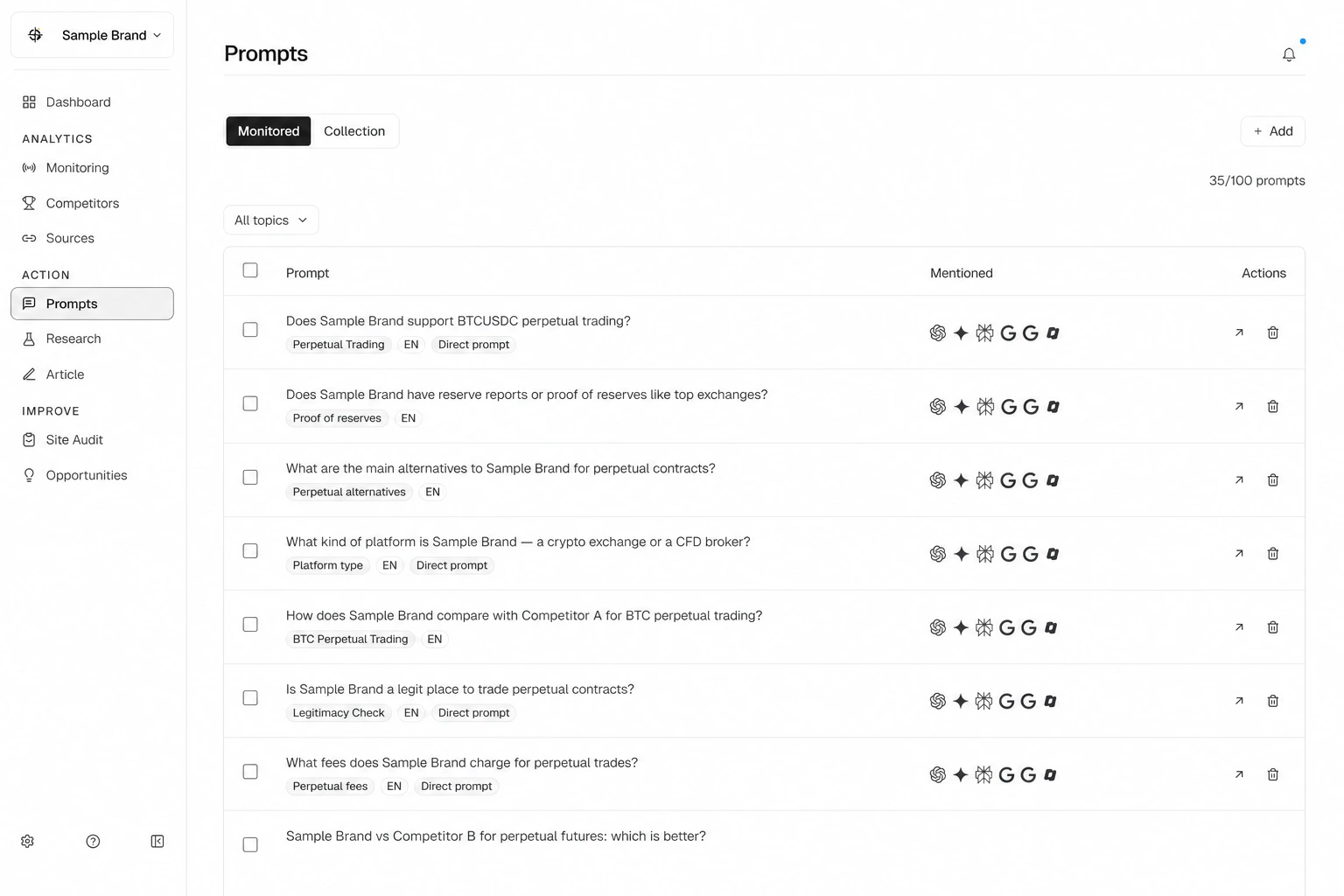
The baseline changes the plan. SignalNest does not publish twenty unrelated articles. It fixes the product description, strengthens one trust page, and writes one category guide for the highest-intent missing question.
The first seven days
- Day 1 — choose five decision questions. Use sales calls, onboarding conversations, competitor comparisons, and founder knowledge. Do not fill the set with broad definitions that cannot change a product or content decision.
- Day 2 — run the ChatGPT baseline. Record whether SignalNest is mentioned, cited, described accurately, or replaced by a competitor. Read the full answer instead of treating the score as the diagnosis.
- Days 3–4 — separate cheap fixes from content work. Correct the canonical product description, unblock relevant crawlers, and strengthen existing trust evidence before commissioning a new article.
- Days 5–6 — ship one high-intent page. Publish the category or use-case page that answers the most valuable missing prompt with direct claims and sources.
- Day 7 — decide what deserves budget. Use the free scan to make the first decision. Upgrade only when the team needs trend history, scheduled tracking, more prompts, more platforms, competitors, research, or exports.
A founder's decision board
| Finding | Likely problem | Cheapest useful action |
|---|---|---|
| Brand absent from a category answer | The site does not own the category or use-case question | Improve one relevant existing page before creating a content cluster |
| Brand mentioned but not cited | The answer knows the name but lacks citable first-party proof | Strengthen the page with direct evidence, source clarity, and crawlable content |
| Product described incorrectly | Canonical messaging or entity signals conflict across the web | Align homepage, product, about, profiles, and structured data |
| Competitor wins the comparison | Its proof is clearer or more widely corroborated | Create a fair comparison page and support the differentiator with evidence |
| All five answers are inconclusive | The prompt set may be too broad or too early in the buying journey | Rewrite the questions before spending on more monitoring |
When content becomes the right investment
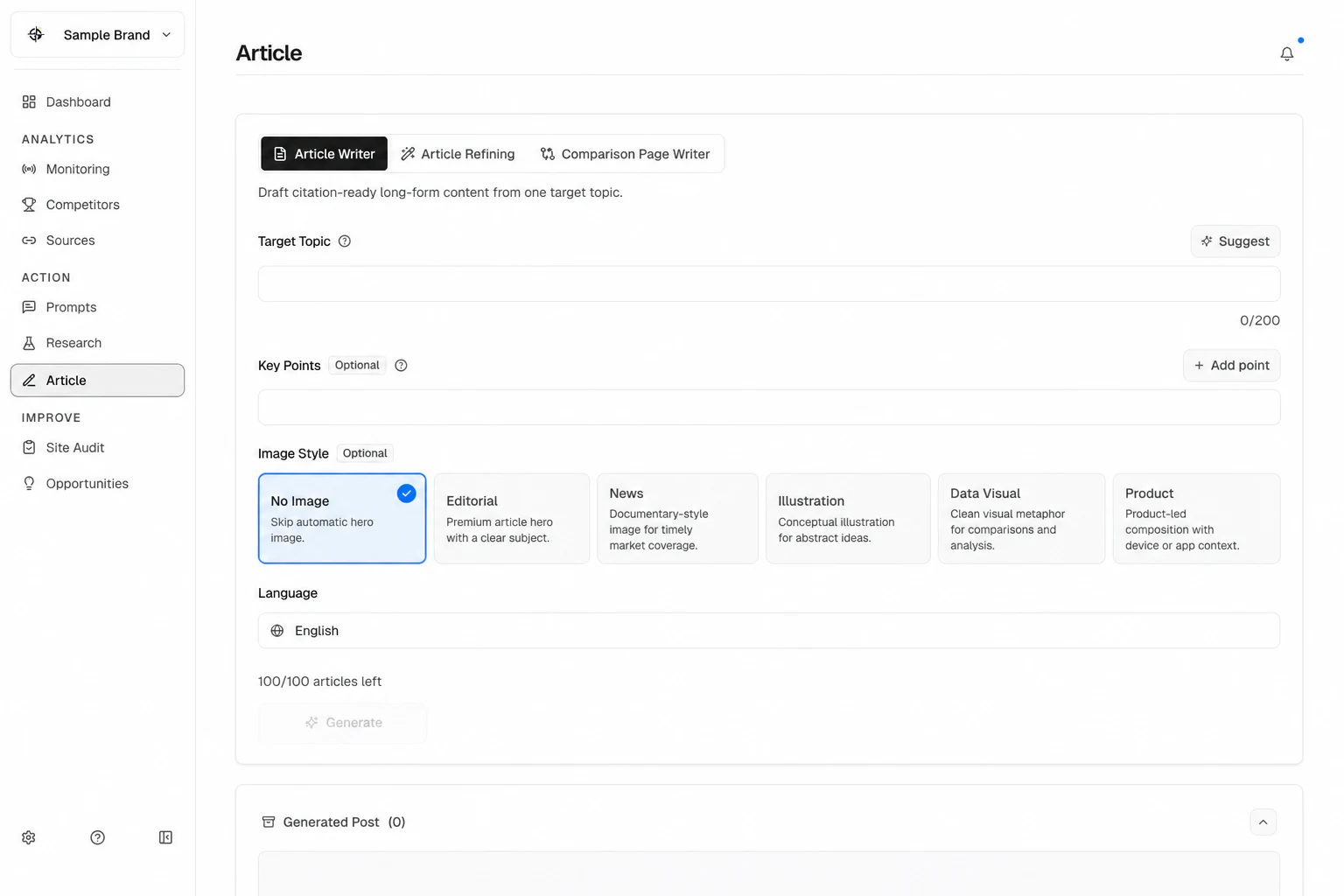
Content is justified when the baseline identifies a specific missing answer the company can credibly own. The target is not “publish more.” It is “become the best source for this buyer question,” with enough product detail, proof, and structure for a person or AI system to verify the answer.
When a startup should upgrade
| Trigger | Why the free baseline is no longer enough | What to add |
|---|---|---|
| More than five buying questions matter | The team is launching new use cases, segments, or products | A larger prompt set organized by buyer stage |
| Platform differences affect decisions | ChatGPT alone does not represent where buyers research | Google AI Overviews, Perplexity, Gemini, or other plan coverage |
| The team needs a trend, not a snapshot | Founders want to compare changes over time | Scheduled tracking with a stable prompt set and denominator |
| Competitors keep winning | The team needs prompt-level battleground and source analysis | Competitor tracking, research, and prioritized opportunities |
| Reporting becomes shared work | Investors, leadership, or a growing marketing team need evidence | Exports, history, and team access |
Three startup moments where this is useful
Before choosing a category position
Test several real buyer phrasings to see which category AI systems already associate with the product and which one would require entirely new evidence. The result supports a positioning discussion; it does not replace customer interviews.
Before hiring an SEO or content agency
Bring the five baseline answers into the brief. A vendor can then propose work against visible gaps instead of selling a generic article count, and the founders retain a stable question set for reviewing progress.
Before entering a new segment
Create prompt variants for the new audience's use case, trust concerns, and comparisons. If the brand is absent or described for the old segment, the team knows which positioning and proof pages must exist before launch.
Why this matters early
Early-stage brands are the ones AI engines are least likely to know, and a small team cannot afford content without a clear reason. Five prompts create a decision boundary: fix messaging and retrieval first, publish only against a demonstrated gap, and expand monitoring when multiple platforms, more questions, or ongoing reporting become operationally useful.
- Free plan: one lifetime onboarding scan across 5 ChatGPT prompts, no credit card.
- Upgrades are immediate and keep existing prompts, brands, and monitoring history.
- Scheduled tracking, competitors, research, exports, and team seats are paid capabilities.
- The first useful output is a prioritized decision, not a large content calendar.
Frequently asked questions
One lifetime onboarding scan across 5 ChatGPT prompts, with no refill. Competitors, research, articles, scheduled tracking, exports, and team seats are paid features.
When the free baseline proves the workflow and you need more platforms (Google AI Overviews, Perplexity, Gemini) or more than 5 prompts. Upgrades take effect immediately.
Often yes — retrievability fixes (server-rendering key pages, unblocking AI crawlers) cost nothing, and one well-structured answer-first page can win citations for its target prompt.
Use one category, one comparison, one trust, one use-case, and one direct-brand question. Replace any prompt that does not connect to a decision the team can make.
No. First check whether the prompt matters to a buying decision, whether the company can credibly answer it, and whether an existing page can be improved. Absence alone is not a content strategy.