Updated 2026-07-07
GEO vs SEO: what changes, what carries over, and where to spend
GEO is not the successor to SEO — it is a second scoreboard layered on top of it. The technical foundation, authority, and intent research that won you rankings still feed AI answers, but the unit of competition shifted from a position on a results page to a citation slot inside a synthesized answer. Keep the foundation; redirect the marginal effort toward citable content structure and measurement on the answer side, where prompt monitoring over scheduled runs is the only honest read.
If you have spent years building organic search traffic, the rise of AI answer engines feels like a threat to the thing that pays your bills. It is reasonable to ask whether the work still matters. The short answer, grounded in how these engines actually work rather than the hype cycle around them: SEO is not dead, GEO is not a replacement, and the two share far more infrastructure than the marketing discourse suggests.
This guide breaks down exactly what carries over, what genuinely changes, and how to allocate effort without doubling your workload — and without abandoning the channel that still sends the majority of search traffic.
The one-paragraph definition
Generative engine optimization (GEO) is the work of making your brand more likely to be retrieved, cited, and recommended inside the synthesized answers produced by ChatGPT, Perplexity, Gemini, Google AI Overviews, and Bing Copilot. Traditional SEO optimizes for a position in a list of links. GEO optimizes for inclusion in an answer that may send no click at all. The same discipline increasingly travels under the name LLM SEO when the emphasis sits on the model itself — the levers are identical.
The distinction matters because it changes what you measure and how you write — but it does not change the fact that an engine has to find and read your pages first. That retrieval step looks a great deal like search.
What carries over from SEO
The foundation you already built is doing more work in AI answers than most GEO guides admit. Four pillars transfer directly.
Technical crawlability and speed. Retrieval-based engines fetch pages the same way search engines do — and they are less forgiving. AI crawlers are impatient, many do not execute JavaScript, and a page they cannot render simply does not exist at the retrieval stage. The technical SEO work that made your site fast and crawlable for Googlebot compounds here. If anything, the bar is higher: an AI-readability audit often surfaces rendering gaps that Google tolerated but AI crawlers will not.
Authority and domain strength. Domains that search engines trust are over-represented in retrieval candidate sets, and third-party coverage feeds both rankings and the training data that shapes how models describe you from memory. The link-building and PR work that built your domain authority is the same work that puts you in front of an AI engine.
Intent research. Keyword research becomes prompt research. The artifact changes from a keyword list to a monitored prompt set, but the underlying skill is identical: knowing what your buyers ask. The vocabulary shifts ("best CRM for agencies" becomes a prompt rather than a keyword), but the research muscle does not.
The Google index specifically. Google AI Overviews and Gemini ground their answers in the Google index, so your Google rankings partially transfer into those answers. If you rank well for a query, you are already a candidate for the AI Overview on that query.
What genuinely changes
Four things shift, and each one changes where you should spend the next hour of effort.
The scoreboard: from position to citation
SEO's outcome is a position you can see and a click you can count in your analytics. GEO's outcome is inclusion in a synthesized answer that sends no signal back to your analytics — if you lose, nothing tells you. This is the single biggest operational change: measurement must move to the answer side. You track citation rate, brand-mention rate, sentiment, and share of voice per platform, measured as rates over scheduled runs of a fixed prompt set rather than from any single check.
This is also where the discourse gets noisy. AI answers vary run to run, so a screenshot proves nothing in either direction. The only defensible number is a rate with a real denominator — X prompts, run on a schedule, tracked over time — and every metric traceable back to the specific answer that produced it. That traceability is the difference between a number you can act on and one you cannot defend in a review.
The winning content shape: from comprehensive to citable
SEO rewarded comprehensive coverage — the 3,000-word definitive guide that captured a topic exhaustively. Synthesis rewards the liftable unit inside it: the direct definition, the specific number, the clean comparison row, the self-contained answer passage.
Research that introduced the term GEO measured this directly. Across nine optimization strategies tested on deployed commercial engines, the tactics that improved visibility most were adding expert quotes and citations (+41% on position-adjusted word count) and fluency and citation density improvements (+28% on subjective impression). The throughline: specificity and attribution win. Vague, adjective-heavy prose gets summarized without credit.
This does not mean long content stops working. It means long content only earns citations when it is built from citable atoms — self-contained answer passages, precise claims, tables that survive extraction — rather than narrative flow that an engine must paraphrase. The practical writing pattern is covered in how to write content AI engines actually cite.
The competitive math: fewer winners per prompt
A traditional results page had ten organic slots plus ads. An AI answer names a handful of brands and cites a handful of sources. Middle-of-page-one visibility — the positions six through ten that a decent SEO effort could buy you — has no AI equivalent. You are in the answer, or you are absent.
This concentrates value. It also creates a surprising opening: analysis of AI citation patterns suggests that nearly half of cited pages would be invisible in traditional search results. The retrieval and synthesis process surfaces content that ranks modestly but answers cleanly. For brands that cannot win page one, GEO is not a consolation prize — it is a genuinely different surface where structure and specificity can outrank raw authority.
The two-layer game: retrieval and training data
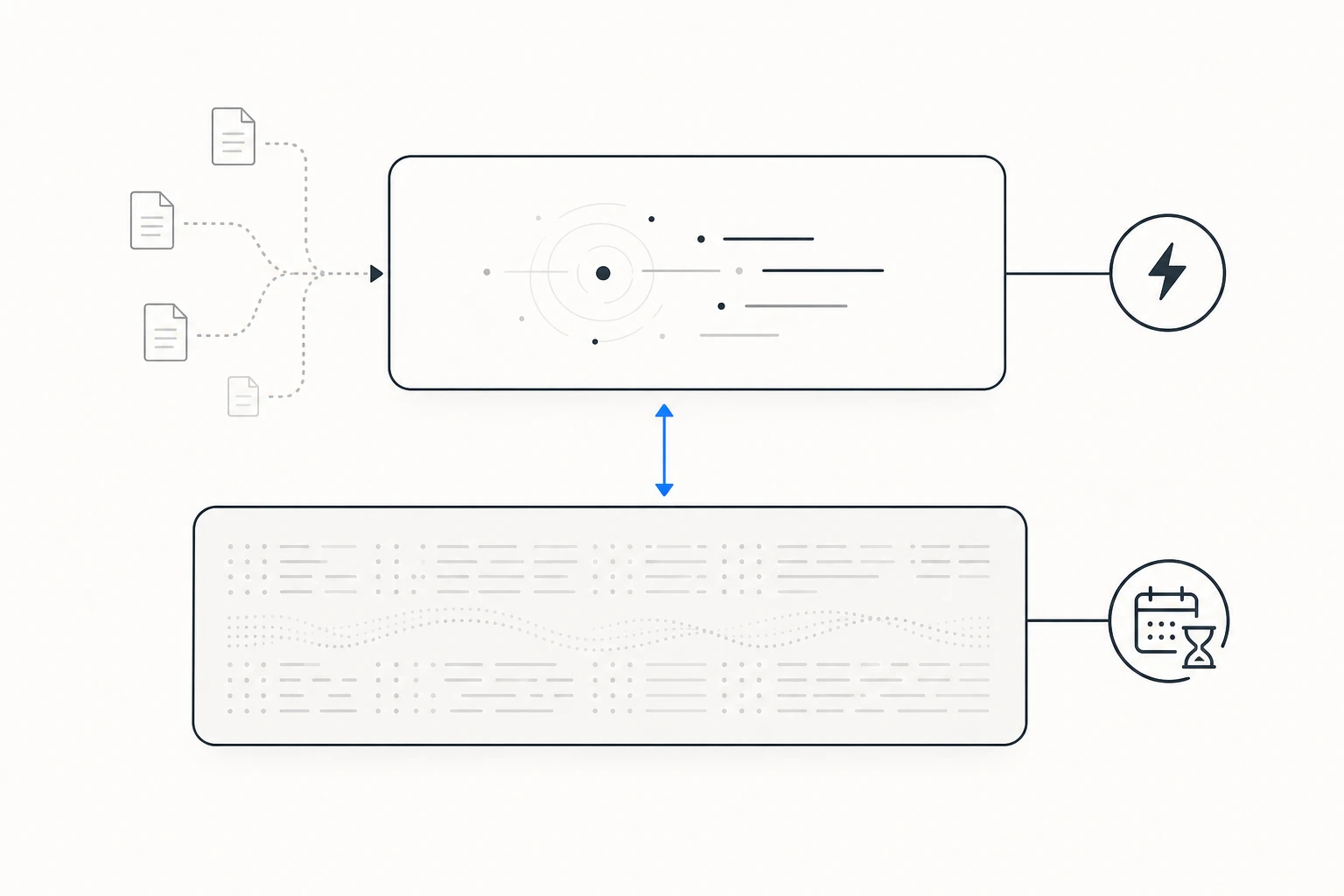
SEO had one index to influence. GEO has two. The retrieval layer is fast and content-responsive — a newly published, well-structured page can be cited within days of being crawled. The training-data layer is slow and reputation-shaped; it is what lets an engine describe your brand from memory when it does not retrieve at all. Some of your effort now goes to entity consistency and third-party presence that no ranking report will ever reflect, but that shapes how the model talks about you when no live fetch happens.
The shared scoreboard trap to avoid
Because the two disciplines overlap so heavily, the temptation is to collapse them into one metric. Resist it. AI search traffic and organic search traffic are not the same currency, and averaging them hides the signal each one carries.
A brand can see strong referral traffic from Google while being nearly invisible in ChatGPT — same domain, same content, different engine, different result. Per-platform measurement is the only way to catch that gap, and per-platform baselines differ by design: Perplexity cites on nearly every answer by default, ChatGPT cites only when it engages web search, so their raw citation rates are not comparable in absolute terms. Trend each platform against itself over time, then compare the trends.
How to run both without doubling the work
Treat GEO as a lens on the same pipeline, not a second pipeline. Three practical merges:
One content calendar, two acceptance criteria. Every page brief answers two questions: does this page have a shot at ranking for the query, and does it contain the passage an engine would lift for the corresponding prompt? If you write the citable atom first and build the long-form around it, you satisfy both.
One measurement stack, two panels. Rankings and traffic on one side, AI visibility metrics on the other. The prompt set is the bridge — each monitored prompt maps to a query you care about for SEO, so the same intent research feeds both.
One cadence. Run your prompt monitoring on a weekly schedule, ship content against the worst gaps, and re-measure on the next cycle. That loop — measure, fix, publish, re-measure — is the whole discipline. Teams that split GEO into a separate silo end up shipping duplicate content and reconciling contradictory numbers.
- Keep: technical SEO, authority building, intent research — they feed GEO directly.
- Add: per-platform prompt monitoring, citable-atom content structure, entity consistency.
- Change: measure answers (citation rate, share of voice), not just clicks and positions.
- Redirect: the marginal position-six-to-ten effort toward citable structure and answer-side measurement.
For a five-minute visual walkthrough of everything above — how the competitive surface changed, and the four tactics that move both scoreboards — the video below covers it concisely.

The starting sequence
If you are standing up GEO work for the first time, the sequence that works:
- Pick 20–50 buyer-intent prompts for your category — comparison, recommendation, and problem prompts, phrased the way buyers actually ask them. This is your targeting list and your measurement denominator.
- Baseline across platforms. Run those prompts on ChatGPT, Perplexity, Gemini, and Google AI Overviews. Record whether you appear, whether you are cited with a link, and how the answer frames you. This baseline alone usually surfaces gaps you did not know existed.
- Audit retrievability. Before rewriting any prose, confirm AI crawlers can actually fetch and read your pages. A page that ranks fine in Google can still be invisible to an AI crawler — JavaScript-dependence, slow responses, or an overbroad robots rule all read as empty.
- Ship citable content against the worst gaps. For each prompt where a competitor is consistently cited and you are not, that prompt is a page brief: write the self-contained answer passage an engine could lift.
- Re-measure on the next cycle. Watch the rate move, not the anecdote. A single citation is a snapshot; a trend is a signal.
This gets tedious past a few dozen prompts run weekly, which is the honest reason monitoring tools exist — not because manual testing is wrong, but because it does not scale, and because a defensible number needs a consistent methodology applied over time.
Frequently asked questions
No — it extends it. Crawlability, authority, and intent research still do the heavy lifting; the new work is optimizing for synthesis and citation and measuring on the answer side. See the budgeting breakdown above for the split.
AI answers are intercepting some clicks whether you participate or not. Being cited in those answers is the compensation — brand presence and the remaining click-throughs — versus absorbing the traffic loss with nothing in return. The two efforts share infrastructure; they are not in competition for budget.
The retrieval layer can cite new content within days of indexing. The training-data layer takes months. Per-platform monitoring shows both timelines honestly — you will see retrieval-driven movement first, and slower reputation effects compound over quarters.
Both, weighted by where your buyers research. Categories with research-heavy purchases are seeing AI answers earlier in the funnel. Before reallocating budget on anecdotes, measure your own prompt set — the split varies sharply by category.