Updated 2026-08-18
What is LLMO? A practical guide to earning citations in AI search
LLMO, or large language model optimization, is the work of making your information easy for AI systems such as ChatGPT and Gemini to understand, mention, and cite accurately. It does not replace SEO. It keeps the search-discovery foundation while improving crawler access, brand clarity, answer structure, and third-party corroboration. Measure the result with a fixed prompt set and separate mention rate, citation rate, recommendation rate, and share of voice.
LLMO has no magic file, prompt trick, or setting that guarantees placement. Google says the same SEO foundations and useful, original content still matter for its generative search features. In practice, the shortest path is to make your information readable, understandable, usable as evidence, and measurable. This guide explains how LLMO relates to SEO, GEO, and AEO, then gives you six actions and a four-week operating plan.
What LLM SEO is
LLMO is the ongoing practice of improving how often generative AI answers can find, understand, mention, recommend, and cite your brand. Its scope includes technical access, product and entity descriptions, content structure, off-site information, and answer-level measurement.
LLMO is an industry term, not a single official standard. It overlaps heavily with generative engine optimization and answer engine optimization. The useful distinction is not the label; it is the channel you are targeting and the result you intend to measure.
| Term | Primary goal | Typical metrics |
|---|---|---|
| SEO | Be discovered and clicked in search results | Rankings, impressions, clicks, organic conversions |
| LLMO | Be understood, mentioned, and cited in LLM-based answers | Mention rate, citation rate, recommendation rate |
| GEO | Earn visibility across generative search experiences | Per-platform visibility and share of voice |
| AEO | Be selected as a clear answer to a question | Answer placements, citations, featured snippets |
SEO is the foundation of LLMO. A page must be indexed and eligible for a search snippet before it can appear as a supporting link in Google AI Overviews or AI Mode. For ChatGPT search, allowing OAI-SearchBot is an important discovery requirement. Neither platform promises placement simply because a technical requirement is satisfied.
How AI search builds answers and citations
AI answers may use knowledge learned during training, information retrieved from the web at answer time, or both. The sources used and the way links appear vary by platform and query. It is more useful to work from the parts you can verify than to guess at an unpublished ranking formula.
1. Interpret the question. AI search can use the user's wording directly or rewrite it into more specific search queries. OpenAI says ChatGPT search may rewrite one question into multiple targeted queries sent to search providers.
2. Retrieve relevant pages. For search-grounded answers, public pages available to the platform's index or crawler can become candidates. Google's generative search features use its core search systems, while OAI-SearchBot access affects whether ChatGPT search can include a site's content in summaries and snippets.
3. Select information for the answer. Each service evaluates retrieved information with its own systems. Relevance, clarity, reliability, and freshness can all matter, but the detailed selection formula is not public and inclusion is never guaranteed.
4. Generate the answer and links. The system summarizes the selected information and may display supporting links or references. Results can change between runs, so one spot check is weaker evidence than a fixed prompt set measured over time.
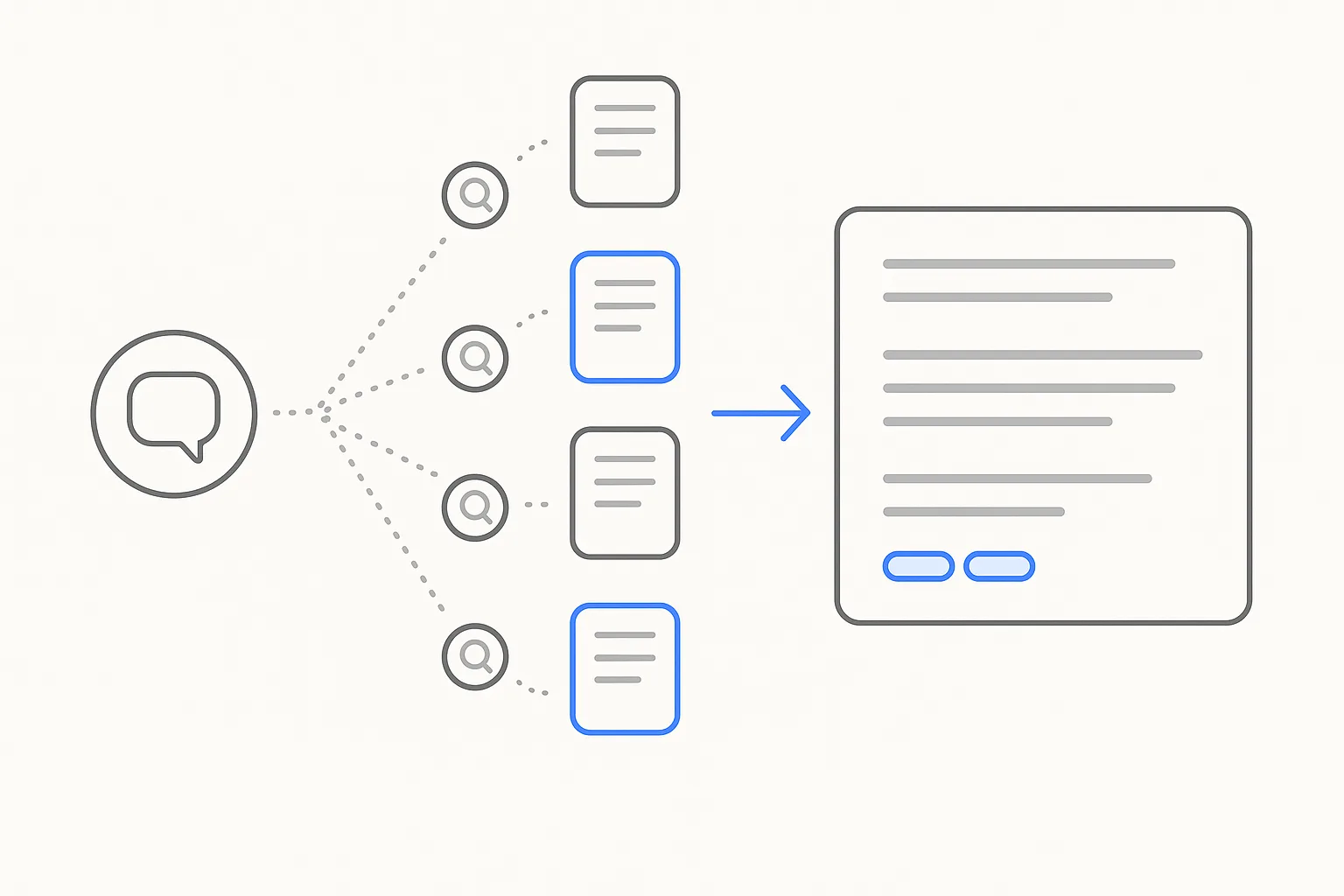
Practitioners can improve two things: whether a page is available for retrieval and whether its information is useful once found. That means reliable crawler access, consistent brand facts, direct answers, verifiable evidence, and agreement with accurate off-site profiles.
How to do LLMO: six practical actions
Everything below is unglamorous, and that is the point: none of it needs a growth hack, just competent publishing applied where engines actually look. Work the factors in order — each one compounds the next, and a weakness in an early one caps everything after it.
1. Machine access — crawlers, robots, and JavaScript
Access. If fetchers cannot load your content, you do not exist to the engine. Confirm robots.txt and meta robots allow the relevant user-agents — general search bots and the AI-specific crawlers — to fetch your key pages, and watch for over-broad folder-level disallows that quietly hide docs or pricing. The AI crawler access benchmark provides a reproducible cross-site comparison of five major agents.
Server behavior. Test your pages with a headless fetch: a 200 status, correct content type, and complete HTML without client-side rendering. If primary content depends on JavaScript, provide server-side rendering or prerendered snapshots. An AI-readability audit exists precisely because pages that look fine in a browser often read as empty to a crawler.
Sitemaps and feeds. Ship XML sitemaps with accurate lastmod values, and expose RSS/Atom feeds for docs and changelogs to hint at freshness.
Stability. Limit interstitials, consent walls, and rate limits that block automated clients. Slow assets make headless renderers time out and conclude the page is empty.
2. Entity clarity
Disambiguation. If your brand shares a name with a product, company, or common noun, an AI answer can confuse the entities. Use the same official name, descriptor, and tagline across your site and profiles, and add one sentence that distinguishes the brand where confusion is likely.
Structured signals. Use Organization and Product markup to assert names, alternate names, and sameAs relationships, and keep handles and domains consistent. The concrete patterns are in how AI engines decide you're "you".
Landing-page alignment. Give each entity one stable URL that answers what it is, who it is for, and how it is used — in skimmable blocks — and link related entities together so clustering works in your favor.
3. Citable structure
Liftable units. Engines favor passages that can be lifted without the rest of the page: a one-sentence definition, a numbered list of steps, a compact comparison row, an explicit price or limit. Place them near the top and label them clearly.
Answer-first writing. Write so a model can extract the answer without scrolling: question-form subheads, short paragraphs, a summary block with definitive statements and specific numbers. The full set of writing rules is in how to write content AI engines actually cite.
Friction. Keep content readable without cookie walls, email gates, or scripts that block text extraction — and make the canonical version the cleanest one.
4. Corroboration and third-party presence
Consistent facts across domains. Information that appears only in your own marketing copy is harder for readers and AI systems to verify. Keep core facts such as company name, category, capabilities, and pricing consistent across official profiles, partners, and relevant directories. The goal is agreement on facts, not duplicated promotion.
Evidence depth. Give each claim a clear primary source: technical specifications in documentation, limitations in support articles, and current numbers on pricing pages. Agreement between your site and accurate off-site profiles also reduces stale or conflicting information.
Narrative shapes. Many prompts arrive as "best X for Y," "alternatives to Z," or "X vs Y." Make sure those comparison frames exist somewhere retrievable, stated cleanly and without over-claiming.
5. Freshness and retrievability
Update paths. Live-retrieval engines revisit sitemaps and feeds. Use lastmod and pubDate accurately, and keep a visible "last updated" line so extracted snippets carry freshness cues.
HTTP hygiene. Keep canonical URLs stable, use 301 redirects when a page moves, and remove soft 404s. Conflicting facts — old pricing on one page and new pricing on another — make the site harder for both people and machines to trust.
Retrieval ergonomics. Avoid infinite scroll on index pages you want crawled; provide paginated archives with clear next and previous links.
6. Per-platform behavior differences
ChatGPT. With browsing on, it fans out across web sources and shows a limited set of inline citations, favoring concise definitional passages and docs for technical queries. Tactics specific to it are in how to get cited by ChatGPT.
Google AI Overviews and AI Mode. These blend corpus knowledge with live retrieval grounded in the Google index, so classic crawl and quality constraints carry over — but the citation unit is an answer paragraph, not a ranked listing. See AI Overviews for how grounding works.
Gemini, Perplexity, and Bing Copilot. Each has distinct retrievers, UI constraints, and citation policies: some prioritize domain diversity, some weigh recency more heavily, some show references at the end rather than inline. Expect different results for the same prompt, and treat each engine as its own channel sharing the same four inputs — access, entity clarity, citable structure, corroboration.
How to start LLMO: a four-week plan
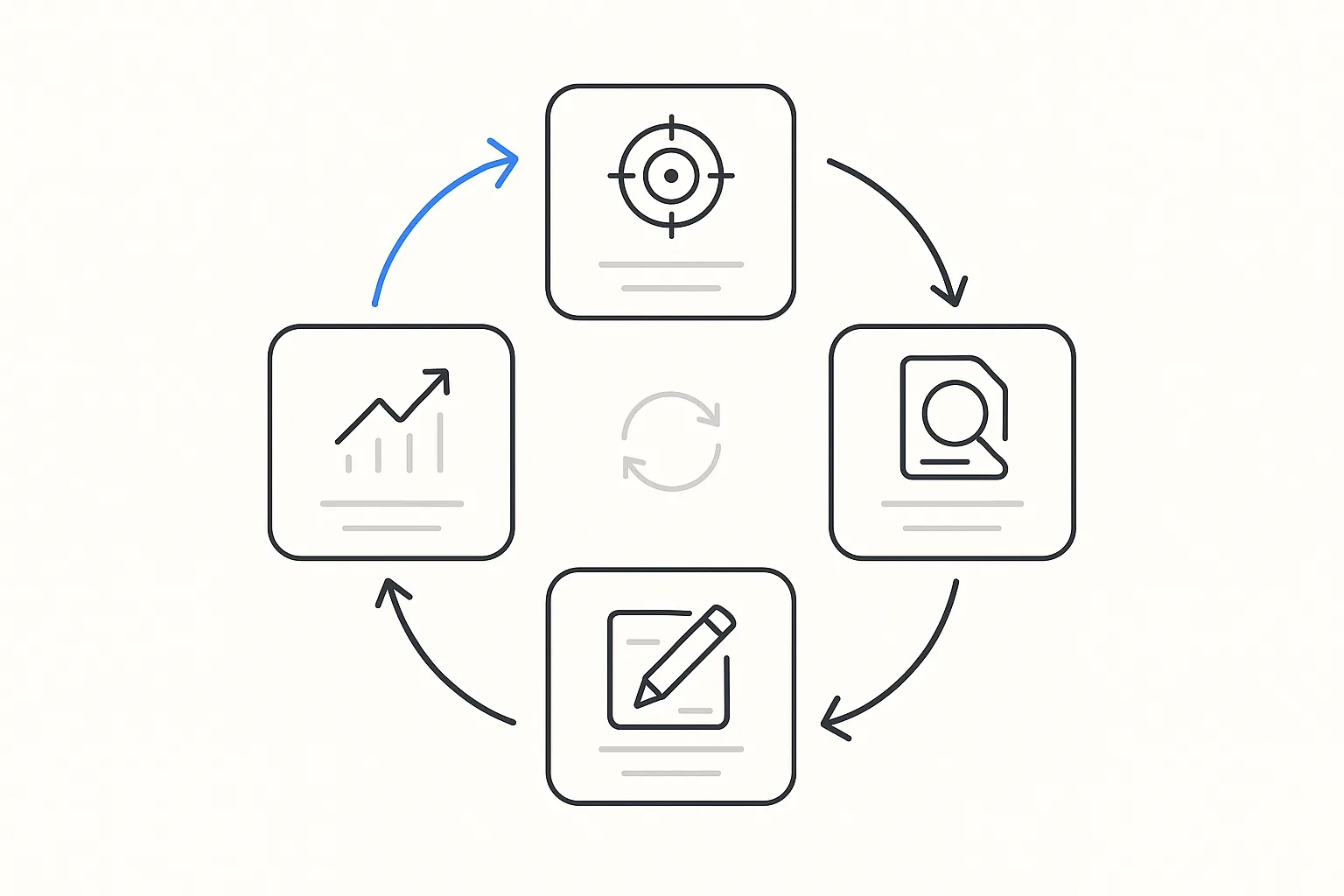
You can run LLM SEO as a tight four-week loop, then repeat. The cadence keeps you close to measurable movement on the prompts that matter to your buyers.
If you only have one hour this week, do the smallest version of Week 1: pick ten buyer prompts, run them on two engines, and save the answers somewhere you can find again. That single baseline — who gets named, who gets cited, where you are absent — usually reframes the entire content roadmap, and everything below just scales it up.
Week 1 — baseline and prompt set
Define the prompt set. Start with 10–25 prompts that represent your commercial surface: "what is [category]," "best [category] for [segment]," "[competitor] alternatives," "[brand] vs [competitor]." The sourcing method is covered in how to find the buyer prompts your customers ask AI.
Run the baseline. For each engine you care about, record the answer, which sources it cited, and whether your brand was mentioned, linked, or recommended. Keep the evidence — an answer you cannot re-open is a number you cannot defend.
Quantify. Compute citation rate and share of voice across the prompt set, by engine and by intent bucket. This baseline is the denominator for everything that follows.
Week 2 — access and entity audit
Crawlability. Validate robots.txt, canonicals, sitemap coverage, and server responses for the pages that should win citations, and fetch them headlessly to confirm the content renders without JavaScript — a site audit automates the checklist.
Entity coherence. Standardize names and descriptors, update Organization and Product markup, add the disambiguation line where needed, and crosslink entity pages.
Retrieval surfaces. Make sure docs, pricing, and comparison pages exist as first-class URLs with clear titles, and expose feeds for anything that changes often.
Week 3 — publish against gaps
Close definitional gaps. Create or refactor the "what is [X]" block for your category and product; add liftable comparison rows and explicit numbers.
Build corroboration. Update the third-party listings that reflect your canonical description, and hand partners a one-paragraph boilerplate with correct links.
Split overloaded pages. Where one URL tries to answer too many intents, split it so each page maps cleanly to a prompt cluster, and align titles and H1s with the prompt language you are targeting.
Week 4 — re-measure and refine
Re-run the prompt set. Compare citation-rate and share-of-voice deltas by engine and prompt cluster; inspect where you were added, where you were dropped, and which sources beat you.
Diagnose misses. For prompts where you are absent, check in order: did fetchers reach the page, does it contain a liftable unit, and is the claim corroborated anywhere else? The failure is almost always one of those three.
Lock the loop. Turn the diagnosis into next sprint's publishing list, keep a monthly re-measurement rhythm, and reserve a weekly slot for quick wins — tightening a definition block, updating a stale number.
How to measure LLMO results
Search rankings alone cannot measure LLMO. Start with a fixed set of real buyer prompts and keep the platform, language, region, and run frequency stable. Track four separate outcomes:
- Mention rate: the share of eligible answers that name your brand.
- Citation rate: the share of eligible answers that link to your domain.
- Recommendation rate: the share of answers that present your brand as an option, comparison, or recommendation.
- Share of voice: your brand's share of all brand mentions within a defined competitor set.
Use seven-day changes to catch missed runs and sudden answer shifts, then use 28-day changes to judge direction. When a number moves, return to the underlying answer, citation URL, platform, and timestamp before assigning a cause. See AI visibility metrics for formulas and reporting examples.
Do you need an LLMO tool?
You can run a basic program manually if the scope stays small: a dozen or two prompts across one or two engines, checked on a schedule, evidence saved to a spreadsheet. That honesty cuts both ways — manual runs break down as engines, prompts, geographies, and stakeholders multiply, not because the method changes but because the bookkeeping does.
Tooling adds repeatability at scale: scheduled runs across the major engines, evidence capture, per-engine share-of-voice and citation-rate rollups, and gap detection by prompt cluster. AEO Mantis does this as one workflow across ChatGPT, Gemini, Perplexity, AI Overviews, AI Mode, and Bing Copilot — see pricing for where the free tier ends and paid plans begin.
- LLMO does not replace SEO. Google generative search still depends on indexable pages and useful, original content.
- To make content available to ChatGPT search, confirm that OAI-SearchBot is not blocked; its purpose is separate from GPTBot training controls.
- Clear definitions, comparison rows, steps, and primary evidence make useful answer passages easier for people and machines to identify.
- Answers and citations can change between runs, so measure a fixed prompt, language, region, and platform set on a schedule.
- Keep mention rate, citation rate, recommendation rate, and share of voice separate, and preserve the underlying answers and citation URLs.
Frequently asked questions
They overlap heavily. LLMO frames the work around large language models, while GEO frames it around the broader generative engine experience. In practice, define the platforms and metrics your team will use instead of debating the label.
Yes. Google requires a page to be indexed and eligible for a search snippet before it can appear as a supporting link in AI Overviews or AI Mode. Crawlability, internal links, useful original content, and accurate information remain the foundation.
For engines that browse, improvements to access, structure, and content can show up within days to a few weeks of being re-crawled. Answers leaning on model memory wait for a training cycle. A monthly measurement rhythm is the realistic pace for seeing stable shifts across a prompt set.
Yes, at small scale: a fixed prompt set, one or two engines, a weekly schedule, and disciplined evidence capture in a spreadsheet. Tooling becomes worth it when prompts, engines, or stakeholders multiply and manual bookkeeping starts skipping runs or losing evidence.
Start where your buyers actually research: for most teams that means ChatGPT and Google AI Overviews first, then Perplexity or whichever engine your niche favors. Validate with a small pilot prompt set before spreading effort across all six supported platforms.
Yes, especially for narrow use cases and industry questions where the brand has specific primary evidence, clear product information, or a verifiable example. Placement is never guaranteed, so focus on important prompts and measure mentions and citations over time.