Updated 2026-09-02
What is AEO? Answer engine optimization explained
Answer engine optimization (AEO) is the practice of making content easy for search engines, AI engines, and voice assistants to retrieve, understand, trust, and cite in a direct answer. It combines traditional SEO foundations with answer-first writing, extractable content blocks, credible evidence, structured data, and ongoing AI visibility measurement. For a compact definition, see the AEO glossary entry; this guide covers the complete workflow.
SEO helps a page become discoverable in search engine results pages (SERPs). AEO helps specific passages from that page appear inside featured snippets, Google AI Overviews, ChatGPT responses, Perplexity answers, voice results, and other AI-generated answers.
AEO does not replace SEO. It adds a citation-first emphasis to the same underlying work.
What does answer engine optimization mean?
An answer engine is a system that responds to a question with a composed answer instead of only presenting a list of links.
Traditional search engines usually help users choose where to look. Answer engines attempt to resolve the question directly by summarizing information from one or more sources. Depending on the platform and query, the answer may include citations, links, product recommendations, brand mentions, images, or follow-up questions.
Answer engine optimization is therefore the process of becoming one of the sources an answer engine can confidently use.
A page prepared for AEO should:
- Answer an identifiable question directly.
- Make important passages easy to extract.
- Support claims with credible sources or first-party evidence.
- Communicate who created or reviewed the content.
- Remain accessible to search and AI crawlers.
- Use semantic HTML and accurate structured data.
- Earn corroboration from trustworthy third-party pages.
- Be monitored for mentions, recommendations, citations, accuracy, and business impact.
AEO developed before the current generative AI wave. Featured snippets already rewarded concise, self-contained answers, while voice assistants often read one result aloud. Generative engines expanded this pattern by synthesizing longer answers from multiple sources.
The competition has moved from earning a place in a list to earning a place inside the answer.
| Search era | Typical surface | Primary opportunity |
|---|---|---|
| Traditional search | Ten blue links and other SERP features | Rank prominently and earn a click |
| Direct answers | Featured snippets and voice assistants | Supply the selected answer passage |
| Generative search | Google AI Overviews, ChatGPT, Perplexity, and similar AI engines | Earn a mention, recommendation, or citation inside a synthesized answer |
This shift also creates more zero-click experiences. A person may learn about a brand, compare products, or form a shortlist without visiting any of the cited websites. That makes brand citations and accurate representation important even when referral traffic is limited.
Why is AEO important?
Online visibility is no longer determined only by rankings. AI systems increasingly influence which brands people discover, trust, compare, and consider.
A buyer might ask:
- “What is AI visibility monitoring?”
- “Which AI visibility tools are best for a SaaS company?”
- “How do I track citations in ChatGPT?”
- “What is the difference between AEO and GEO?”
- “Which platform supports multiple AI engines?”
The response may mention only a few brands. Those brands can enter the buyer's consideration set before the buyer visits a conventional search result.
This creates a new visibility landscape with several important characteristics:
- Fewer visible options. AI-generated answers usually name fewer sources or products than a complete SERP.
- AI-influenced perspectives. The framing of the answer can shape how a category, problem, or brand is understood.
- Silent shortlists. Buying committees may discover and compare vendors through AI-powered tools without producing an attributable website visit.
- Distributed authority. Brand perception is influenced by the company's website, community forums, social platforms, reviews, partner pages, media coverage, and other third-party ecosystem presence.
- Answer volatility. Different AI engines can produce different recommendations, citations, and descriptions for the same question.
- Reduced click visibility. A brand can gain influence through an uncited mention or lose an opportunity without seeing either event in conventional analytics.
The result is not the end of search marketing. It is a broader definition of visibility—one that includes rankings, featured snippets, knowledge panels, AI citations, voice results, recommendations, and brand presence across the wider information ecosystem.
What is the difference between AEO, SEO, and GEO?
AEO, SEO, and generative engine optimization (GEO) overlap substantially. They describe different layers of the same discovery system.
| Discipline | Primary emphasis | Typical activities | Common measurements |
|---|---|---|---|
| SEO | Discovery and rankings in search results | Keyword research, technical SEO, internal links, content quality, backlinks, and SERP optimization | Rankings, impressions, clicks, traffic, and conversions |
| AEO | Supplying direct, extractable answers | Question-based keyword research, answer-first passages, Q&A formatting, schema markup, and citation tracking | Answer presence, featured snippets, recommendation rate, citation rate, and voice results |
| GEO | Brand visibility across generative engines | Entity consistency, third-party corroboration, brand authority, prompt monitoring, and ecosystem presence | Brand mentions, share of answer, citation share, recommendation presence, and competitive visibility |
SEO creates the discovery foundation. If a page cannot be crawled, indexed, rendered, or understood, it is unlikely to become a dependable source for retrieval-based AI systems.
AEO focuses more closely on the answer unit: the paragraph, list, table, definition, or product fact that can be extracted and used independently.
GEO adds the broader brand and ecosystem layer. It asks whether AI engines consistently understand the organization, trust its claims, find corroborating evidence, and include it when generating recommendations. The practical work includes entity consistency and measuring share of voice across engines.
Backlinks can support authority and discovery, but AEO is not simply backlink building under a new name. A page still needs a direct answer, semantic relevance, reliable evidence, and an extractable structure. Likewise, publishing more words does not guarantee more AI citations.
In practice, most teams do not need three separate programs. One coordinated search strategy can use SEO for discovery, AEO for answer extraction, and GEO for brand authority across AI platforms. For budget and channel tradeoffs, see GEO vs SEO.
How does an answer engine select sources?
Each platform uses its own systems, and those systems change over time. However, a useful planning model has four stages.
1. Interpret the question
The engine identifies the likely user intent and expected answer format.
A definition question usually needs a concise explanation. A comparison question may require a table. A process question usually benefits from ordered steps. A buying question may require selection criteria, product facts, and evidence from multiple sources.
This is why question-based keyword research matters. The content should reflect the question a person is trying to resolve, not merely repeat a target keyword.
2. Retrieve possible sources
A retrieval-enabled system may search an index, browse current pages, consult a knowledge graph, or combine several sources.
Pages may fail at this stage because:
- The relevant AI crawlers cannot access them.
- Important content is hidden behind authentication or client-side interactions.
- The page is not indexed or internally linked.
- The canonical URL is inconsistent.
- The content is rendered unreliably.
- Product data is incomplete or outdated.
Crawler access optimization is therefore a prerequisite, not a guarantee of inclusion. The broader mechanics are covered in how LLMs decide what to cite.
3. Extract useful passages
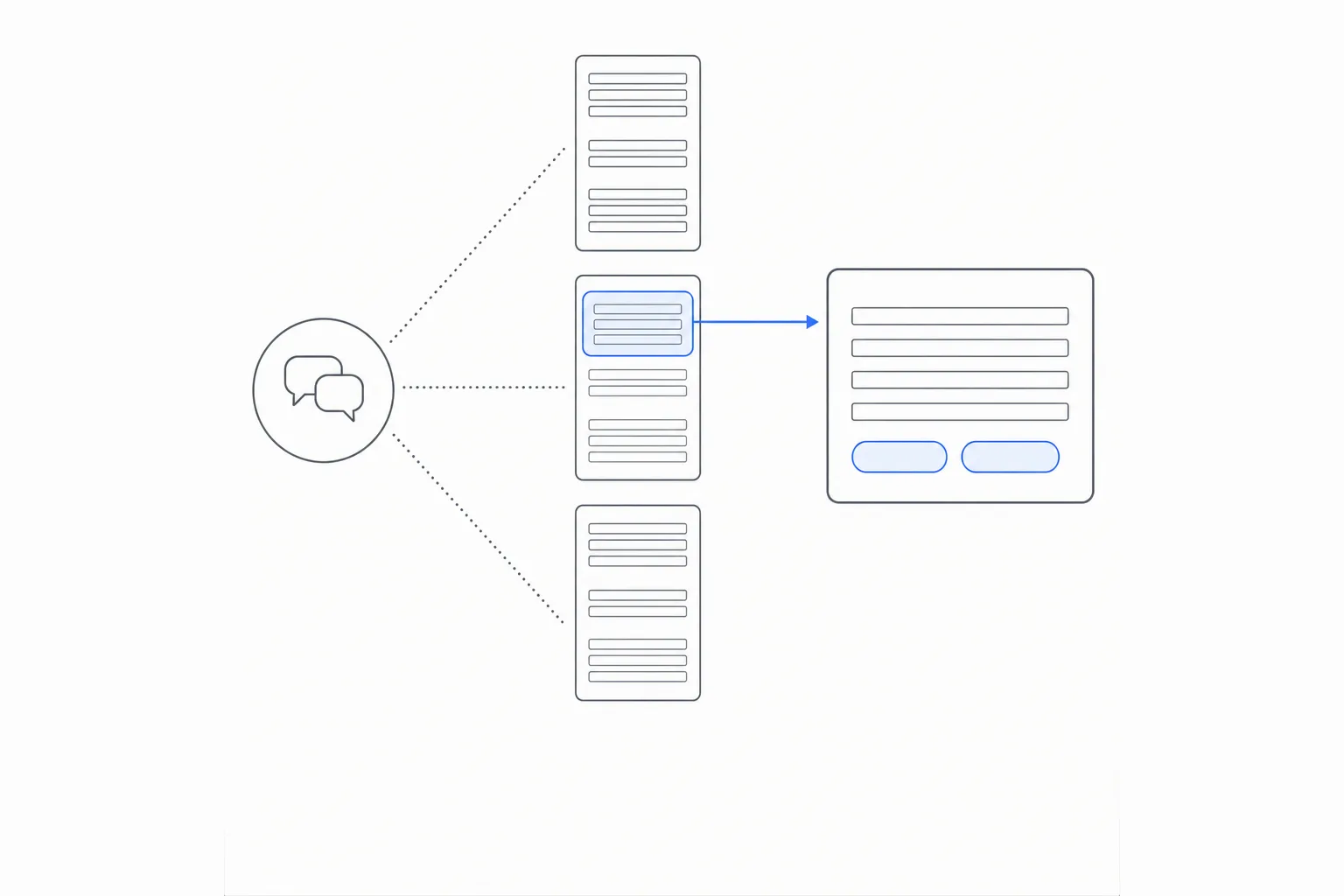
Retrieval systems commonly divide documents into smaller passages or chunks. A passage is easier to use when it answers one question, makes sense independently, and includes facts that can be checked.
Atomic paragraph structures help because each paragraph carries one complete idea. Modular content blocks—such as definitions, steps, comparisons, specifications, and FAQs—make the page easier to interpret and reuse.
A passage beginning with “as mentioned above” loses meaning when separated from its surrounding text. A self-contained passage that restates the subject can survive extraction.
4. Generate and attribute the answer
The engine combines selected information into an answer. It may mention sources, cite URLs, recommend products, or provide no visible attribution.
Claims supported by several credible sources are generally easier to trust than unsupported statements from one page. This is where brand authority, authoritativeness, content origins, and third-party corroboration affect the result.
Selection criteria can also be proprietary. Two AI engines may use different indexes, retrieval methods, ranking signals, model instructions, freshness requirements, or citation policies. A page can therefore appear in Perplexity but not ChatGPT, or in a featured snippet but not a Google AI Overview.
AEO should be measured across the platforms buyers actually use rather than assuming one result represents the entire market.
What makes content easy to cite?
A citable answer unit normally has five characteristics.
A heading that matches the question
Use a descriptive heading that clearly states what the section answers. Clever or ambiguous headings provide less context than direct question-based headings.
An answer-first opening
State the conclusion in the first one or two sentences. Background, examples, qualifications, and supporting evidence can follow.
Self-contained meaning
The passage should remain understandable when removed from the rest of the page. Resolve pronouns, name the subject, and avoid relying on earlier sections.
Verifiable evidence
Use concrete mechanisms, limitations, dates, examples, methods, or first-party data. Explain where important claims came from and what the evidence can and cannot prove.
The correct answer shape
Match the content format to the question:
- Use a concise paragraph for a definition.
- Use numbered steps for a process.
- Use a table for a meaningful comparison.
- Use bullets for criteria or requirements.
- Use visible Q&A content for genuine follow-up questions.
- Use structured product data for factual product attributes.
This approach improves extractability without reducing the article to disconnected fragments. Each section should work independently while contributing to a coherent explanation. The complete writing rules are in how to write content AI engines actually cite.
What content and technical foundations support AEO?
Strong AEO depends on both editorial quality and technical accessibility. Neither can compensate completely for the absence of the other.
Semantic HTML
Use one descriptive H1, logical H2 and H3 headings, real lists, accessible tables, and meaningful link text. Semantic HTML helps crawlers distinguish headings, answers, steps, comparisons, and supporting details.
Crawlability and indexability
Confirm that relevant search and AI crawlers can access the canonical page. Check robots directives, authentication requirements, rendering, status codes, canonical tags, and internal links.
Allowing a crawler does not guarantee that a platform will retrieve, cite, or train on the page. Different crawler controls can apply to search retrieval, user-triggered browsing, and model training.
Core Web Vitals and reliable rendering
Core Web Vitals do not directly create AI citations, but reliable and responsive pages are easier for people and automated systems to use. Important answers should appear in the rendered HTML without requiring fragile interactions.
Atomic paragraphs and modular blocks
Organize the page so each paragraph communicates one primary idea. Definitions, evidence, processes, limitations, and examples should be identifiable without depending on decorative layout.
Schema markup
Use structured data only when it accurately represents visible content. Depending on the page, this might include Article, Organization, Person, Product, SoftwareApplication, BreadcrumbList, or FAQPage markup.
FAQ schema does not guarantee a rich result or AI citation. It clarifies the content's meaning; it does not make weak content authoritative.
Structured product data
Product and commerce pages should expose accurate names, categories, features, pricing conditions, availability, supported markets, and limitations.
For organizations developing a commerce AI framework, the same principle applies across websites, feeds, APIs, and partner listings: product facts should be complete, current, and consistent. Contradictory structured product data makes reliable recommendations harder.
E-E-A-T and author authority signals
Experience, expertise, authoritativeness, and trust are established through evidence, not by repeating an acronym.
Useful E-E-A-T signals include:
- A named author or qualified reviewer.
- A clear publication and update date.
- First-hand examples or original research.
- Transparent methods and limitations.
- Sources for material factual claims.
- Accurate company and contact information.
- Corrections when information changes.
- Consistency between on-site claims and third-party descriptions.
Author authority signals are strongest when the author's demonstrated experience is relevant to the subject.
Digital provenance indicators
Digital provenance indicators help readers and systems understand where content originated and whether it remains current. Examples include the author, reviewer, publication date, last-updated date, research method, source links, data period, and material correction history.
Provenance should clarify evidence, not create a false appearance of certainty.
How do you optimize a page for AEO?
A practical answer engine optimization workflow has ten steps.
1. Select one important buyer question
Begin with a real problem a customer is trying to solve. Use customer interviews, sales calls, support tickets, site search, Search Console, first-party buyer data, competitor research, and SERP analysis.
Include informational, comparison, recommendation, and buying-stage questions. Category prompts such as “best AI visibility tools” often reveal a different competitive set from branded prompts about one company.
2. Identify user intent and the expected answer format
Determine whether the reader needs a definition, process, comparison, recommendation, troubleshooting guide, or product fact.
Review the current SERP, featured snippets, AI Overviews, and cited competitor pages. Look for necessary subtopics, but do not copy the competitor structure mechanically.
3. Write the direct answer first
Place a concise, self-contained answer immediately beneath the matching heading. State the conclusion before the history or explanation.
For example:
Answer engine optimization is the practice of structuring and supporting content so answer engines can retrieve, understand, and cite it in direct responses.
That sentence works independently and can be followed by qualifications.
4. Add original and verifiable support
Support important claims with first-party data, product evidence, expert review, documented methodology, or credible external sources.
Case studies can be especially useful when they disclose:
- The starting condition.
- The change that was made.
- The measurement period.
- The platforms or questions tested.
- The outcome.
- Important limitations or alternative explanations.
Do not invent statistics or imply causation when the evidence only shows correlation.
5. Restructure the page into extractable answer units
Use question-form headings, atomic paragraphs, short definitions, ordered steps, and meaningful comparison tables.
Each important block should answer one question and remain understandable outside the article.
6. Strengthen technical access
Confirm that the page:
- Returns a successful status.
- Uses one canonical URL.
- Is internally linked.
- Can be rendered without requiring a login.
- Is not unintentionally blocked from relevant retrieval crawlers.
- Uses semantic HTML.
- Performs reliably on mobile and desktop.
- Includes accurate structured data where appropriate.
7. Build a credible evidence chain
Record who owns each claim, where the evidence originated, when it was reviewed, and what limitations apply.
For sensitive claims, establish an approval process before publication. Removing a claim that cannot be supported is often better than surrounding it with vague language.
8. Strengthen the third-party ecosystem
Review how the brand is described on:
- Industry publications.
- Review platforms.
- Partner pages.
- Community forums.
- Social platforms.
- Company databases.
- Comparison articles.
- Customer case studies.
- Relevant media coverage.
These third-party pages can reinforce or contradict the company's own description. The goal is not to manufacture mentions. It is to make accurate, useful information available wherever legitimate conversations about the category occur.
9. Apply a platform strategy
Different answer engines expose different evidence. Google may connect an AI Overview with traditional search results and knowledge panels. Perplexity commonly displays source links prominently. ChatGPT may browse and cite sources in some experiences while answering from other information in others. Voice assistants may return only one short result.
Use a common factual foundation across platforms, then monitor the surfaces that matter to the target audience. Avoid creating contradictory versions of the same claim for different engines.
10. Measure, learn, and refresh
Establish a baseline before editing the page. Repeat the same question set after publication and compare mentions, recommendations, citations, accuracy, cited URLs, competitors, referral activity, and conversions.
A visibility score can summarize progress, but it should never replace the underlying answer evidence.
Why is AEO difficult for organizations?
AEO crosses SEO, editorial, product marketing, public relations, analytics, engineering, legal review, and brand governance. A writer can create an extractable passage but cannot independently approve product claims, change crawler access, correct inaccurate third-party pages, or connect a recommendation to revenue.
The primary challenge is often organizational readiness rather than writing technique.
Unclear ownership
Assign owners for:
- Question and keyword research.
- Content briefs.
- Product and factual claims.
- Author or expert review.
- Technical access.
- Structured data.
- Third-party corrections.
- Monitoring and reporting.
- Refresh decisions.
Without ownership, teams optimize different parts of the same customer question without producing one dependable answer.
Weak content origins and authorship
Teams should be able to explain where a claim came from, who wrote or reviewed it, when it was validated, and what evidence supports it.
This matters especially when AI-assisted content production is used. AI-powered tools can assist with organization and drafting, but a qualified human should verify factual claims, product details, source quality, and final recommendations.
Branded versus unbranded AI search
Branded prompts reveal whether AI engines understand the company accurately. Unbranded prompts reveal whether the brand is considered when buyers ask about the wider category.
Both are necessary:
- Branded questions diagnose entity clarity and factual accuracy.
- Unbranded category prompts diagnose competitive visibility and recommendation presence.
- Comparison questions reveal how the brand is positioned against alternatives.
- Buying-stage prompts show whether it enters the shortlist used by decision-makers.
Buying committees and hidden influence
A person researching with ChatGPT or another AI engine may share the conclusion internally instead of clicking a source. Several members of a buying committee can also use different platforms during the same decision.
This creates AI-influenced perspectives that are difficult to capture with last-click analytics.
On-site and third-party inconsistency
A company cannot build authority entirely on its own domain. AI engines may compare first-party claims with reviews, community discussions, social content, partner pages, and independent publications.
An on-site claim that conflicts with credible third-party evidence can weaken trust. A consistent ecosystem presence strengthens brand authority and reduces ambiguity.
Missing governance
A lightweight AI governance policy should define:
- Approved evidence sources.
- Claim owners and reviewers.
- How AI-generated drafts are checked.
- Review and expiration dates.
- Rules for regulated or sensitive topics.
- How inaccurate AI answers are documented and escalated.
- Which monitoring data can be shared.
- When a page should be corrected, expanded, consolidated, or removed.
The policy does not need to become a large bureaucracy. It needs to make responsibility and evidence clear.
What does AEO look like in practice?
Consider a software company with a page targeting the question “How do I measure AI visibility?”
The original page opens with several paragraphs about the growth of artificial intelligence. It eventually lists product features but never defines AI visibility, explains the measurement method, or shows which metrics matter.
An AEO-focused revision would:
- Add a direct definition below a matching heading.
- Explain the difference between brand mentions, recommendations, and citations.
- Include a table of AEO KPIs.
- Describe how prompts, platforms, dates, and answer evidence are recorded.
- Explain limitations in attribution and answer volatility.
- Add an expert reviewer and evidence date.
- Connect the page to related definitions and methodology pages.
- Verify crawler access and structured data.
- Monitor the same buyer questions before and after the change.
- Compare business outcomes instead of relying only on a content score.
Nothing in this process guarantees a citation. The revision improves the page's semantic relevance, extractability, verifiability, and usefulness to both people and retrieval systems.
Successful case studies should report the complete method, not only the final visibility score. Readers need to know which prompts, engines, competitors, countries, languages, and dates were included before they can interpret the result.
How do you measure and track AEO and AI visibility success?
AEO success should be measured across four layers: search discovery, answer presence, answer quality, and business impact. Traditional SERP tracking remains useful, but rankings alone cannot show whether ChatGPT, Google AI Overviews, Perplexity, voice assistants, or other AI engines mention, recommend, or cite your brand.
Start with a stable measurement baseline
Create a fixed set of prompts based on genuine buyer questions. Include:
- Branded prompts about the company or product.
- Unbranded category prompts.
- Comparison and recommendation prompts.
- Informational questions that may trigger featured snippets or AI-generated answers.
- Buying-stage questions used by decision-makers and buying committees.
Run the same prompts across the same platforms, markets, and languages on a consistent schedule.
For every answer, record:
- The complete prompt.
- The platform and model or experience when identifiable.
- The date and market.
- The generated answer.
- Brand and competitor mentions.
- Product recommendations.
- Cited sources and destination URLs.
- Sentiment and factual accuracy.
- The action taken after reviewing the result.
Without a stable question set, changes in AI visibility cannot be separated from changes in the test itself. The process for choosing useful questions is covered in choosing prompts to monitor.
Track four layers of AEO performance
| Measurement layer | AEO KPIs | What the layer explains |
|---|---|---|
| Search discovery | SERP position, impressions, clicks, featured snippets, AI Overview presence, and AI referral sessions | Can people and retrieval systems discover the page? |
| Answer presence | Brand mention rate, AI recommendation rate, citation rate, citation-source share, share of answer, and competitive share of voice | Does the brand earn space inside relevant answers? |
| Answer quality | Sentiment, factual accuracy, cited URL, claim-to-source match, and competitor framing | Is the answer correct, favorable, and properly supported? |
| Business impact | Qualified visits, registrations, demos, assisted conversions, self-reported attribution, influenced pipeline, and revenue | Does AI visibility contribute to a valuable customer outcome? |
Measure answer presence
Useful answer-presence metrics include:
- Brand mention rate: The percentage of tracked prompts where the brand appears.
- AI recommendation rate: The percentage of eligible comparison or buying prompts where the brand is recommended.
- Citation rate: The percentage of tracked answers containing an AI citation to the company's domain.
- Citation-source share: The company's share of all cited sources across the monitored answers.
- Share of answer: The brand's share of all relevant brand mentions within the fixed prompt set.
- Competitive share of voice: Visibility compared with named competitors across the same questions and platforms.
- Voice-result presence: The percentage of relevant voice queries where the brand or content supplies the spoken answer.
“Share of model” is not a standardized metric. If an organization uses it, the calculation should be stated explicitly. For example, it could mean the percentage of monitored AI platforms that mention the brand for a fixed set of questions.
An opaque visibility score is difficult to act on. The underlying prompts, answers, citations, and scoring method should remain available for review.
Measure answer quality
A mention is not automatically positive or accurate. Sentiment and accuracy monitoring should determine:
- Whether the brand is represented positively, neutrally, or negatively.
- Whether product features, positioning, pricing, and limitations are correct.
- Whether a citation supports the generated claim.
- Whether the engine cites the preferred current page or an outdated source.
- Which competitors appear beside the brand.
- Whether the answer reflects the intended user audience.
- Whether important qualifications were omitted.
Citation and source tracking should preserve the exact response and cited URL. This distinguishes a genuine AI citation from an uncited brand mention and helps teams correct inaccurate information at its source.
Measure business impact
Connect AI visibility to business outcomes instead of treating mentions as the finish line.
Track:
- Qualified sessions from identifiable AI referral traffic.
- Registrations, report completions, trials, demos, and other primary conversions.
- Assisted conversions where an AI visit occurred earlier in the journey.
- Self-reported attribution from a “How did you hear about us?” field.
- Sales conversations mentioning ChatGPT, Perplexity, Google AI Overviews, or another AI-powered tool.
- Influenced pipeline or revenue where the evidence supports the connection.
AI visibility ROI should be treated as directional unless the full journey is observable. AI-generated answers can influence brand perception and create silent shortlists without producing a direct click.
Combining referral analytics, assisted conversions, sales feedback, and self-reported attribution creates a more useful estimate than last-click reporting alone.
Use evidence instead of one composite score
AI visibility tools can automate prompt execution, AI citation tracking, brand-mention monitoring, recommendation-rate calculations, competitor comparisons, and historical reporting.
A spreadsheet can support a small prompt set if it records the prompt, platform, date, complete answer, cited sources, sentiment, accuracy, and next action. As the number of questions, engines, competitors, markets, and stakeholders grows, dedicated monitoring tools reduce manual work and make trends easier to compare.
The tool should retain answer-level evidence so every metric can be audited. The interpretation framework in AI visibility metrics turns those trends into the next publishing or correction decision.
Review results on a fixed schedule
Establish a baseline before changing the page. Compare the same AEO KPIs after 30, 60, and 90 days while continuing conventional SERP tracking.
Interpret the patterns:
- If rankings improve but AI citations do not, review extractability, authority, and claim support.
- If mentions increase but recommendations do not, review category relevance and selection criteria.
- If citations increase but the answer is inaccurate, correct the source facts and conflicting third-party information.
- If visibility improves without conversions, review user intent, offer relevance, and the call to action.
- If one platform improves while another declines, investigate platform-specific retrieval and source behavior before rewriting everything.
The objective is not simply to maximize brand mentions. Successful AEO produces accurate recommendations, relevant citations, qualified discovery, and measurable business outcomes. When the problem is broader representation rather than one answer block, use the brand visibility playbook.
How is AEO changing search and marketing?
Search is becoming a combination of results pages, direct answers, conversational search experiences, and AI-assisted actions.
AI-generated answers will coexist with SERPs
Traditional results, featured snippets, knowledge panels, local results, shopping units, and AI Overviews can appear in the same search journey. SEO remains necessary because search indexes and authoritative web pages continue to supply discovery and retrieval infrastructure.
Conversational search will create longer journeys
Users can refine a question repeatedly instead of opening a new query for every step. Content must therefore answer the primary question and the most relevant follow-up questions without becoming unfocused.
AI agents may act on recommendations
Agentic commerce could move some experiences from “Which product should I choose?” to “Compare these products and complete the next step.”
Accurate structured product data, availability, pricing conditions, return policies, and entity consistency become more important when an AI system is helping a person act rather than only research.
Monitoring will become continuous
A quarterly ranking report cannot explain a fast-changing answer environment. Teams will increasingly combine AI search analytics, citation data, SERP tracking, brand-perception monitoring, and conversion evidence.
Some platforms describe automated optimization assistants as a GEO agent: an AI-powered tool that monitors prompts, identifies visibility gaps, and proposes content or authority improvements. Such tools can accelerate analysis, but their recommendations still require human verification.
Brand authority will extend beyond the website
Community forums, social platforms, reviews, partner pages, expert commentary, and independent publications can all influence how large language models and retrieval systems understand a brand.
A strong third-party ecosystem presence does not mean appearing everywhere. It means being represented accurately in the sources the audience already trusts.
Visibility will become a portfolio of signals
No single number will describe search performance completely. Teams will need to evaluate rankings, citations, recommendation presence, share of answer, share of voice, answer accuracy, sentiment, qualified traffic, and assisted conversions together.
What five-minute AEO test can you run today?
Choose one question that begins an important customer journey.
For example:
- “What is [your category]?”
- “How do I solve [customer problem]?”
- “Best [category] tools for [audience].”
- “[Your brand] versus [competitor].”
Then:
- Ask the same question in Google, ChatGPT with web access, and Perplexity.
- Record which brands are mentioned or recommended.
- Record the cited sources and URLs.
- Open one cited page and locate the passage that supports the answer.
- Compare its structure and evidence with your own page.
- Find the first sentence on your page that answers the question directly.
- Check whether that sentence remains understandable when copied alone.
- Verify that crawlers can access the canonical page.
- Save the answers as your baseline.
- Repeat the same test after making a substantive improvement.
This test does not produce a complete AEO strategy, but it reveals who currently owns the answer and why their content may be easier to retrieve or cite.
- SEO supports discovery; AEO adds passage-level structure and answer-layer measurement.
- A mention, recommendation, and citation are different outcomes and should be tracked separately.
- Schema markup helps systems interpret visible content but does not guarantee selection.
- Branded prompts diagnose accuracy; unbranded prompts diagnose category visibility.
- The final goal is accurate visibility that contributes to customer trust and business outcomes.
Frequently asked questions
AEO and GEO address the same shift toward generated answers, but emphasize different layers. AEO focuses on direct, extractable answer units. GEO adds brand authority, entity consistency, third-party corroboration, and competitive visibility across generative engines.
No. AEO depends on SEO foundations including crawlability, indexability, user intent, internal links, semantic HTML, useful content, and authority. It extends SEO by optimizing the passages and evidence used inside direct answers.
No. FAQ schema can clarify visible question-and-answer content, but it does not guarantee a rich result, AI mention, or citation. The answer still needs to be relevant, accurate, self-contained, credible, and accessible.
Backlinks can help discovery and authority, but they are only one part of AEO. Brand citations, expert evidence, content quality, entity consistency, third-party descriptions, and extractable answers also matter.
There is no fixed timeline. Results depend on crawling, indexing, retrieval behavior, competition, authority, and how often a platform updates its information. Establish a baseline and monitor a stable prompt set instead of promising a universal timeframe.
AI-assisted content can perform when it is useful, accurate, original, and reviewed by someone qualified to validate it. Unverified summaries, invented claims, and generic rewrites provide weak evidence and can damage trust.
Begin with brand mention rate, AI recommendation rate, citation rate, cited URLs, answer accuracy, competitive share of voice, qualified AI referral traffic, and relevant conversions. Add more metrics only when they support a specific decision.
A mention names the brand inside an answer. A citation links or attributes part of the answer to a source. A brand can be mentioned without being cited, and a company page can be cited without the brand receiving a prominent recommendation.
Choose a small set of high-value buyer questions, improve the corresponding canonical pages, verify technical access, and manually record answers from two or three relevant platforms. A spreadsheet is sufficient until recurring monitoring becomes too time-consuming.